


The year is 1944 …
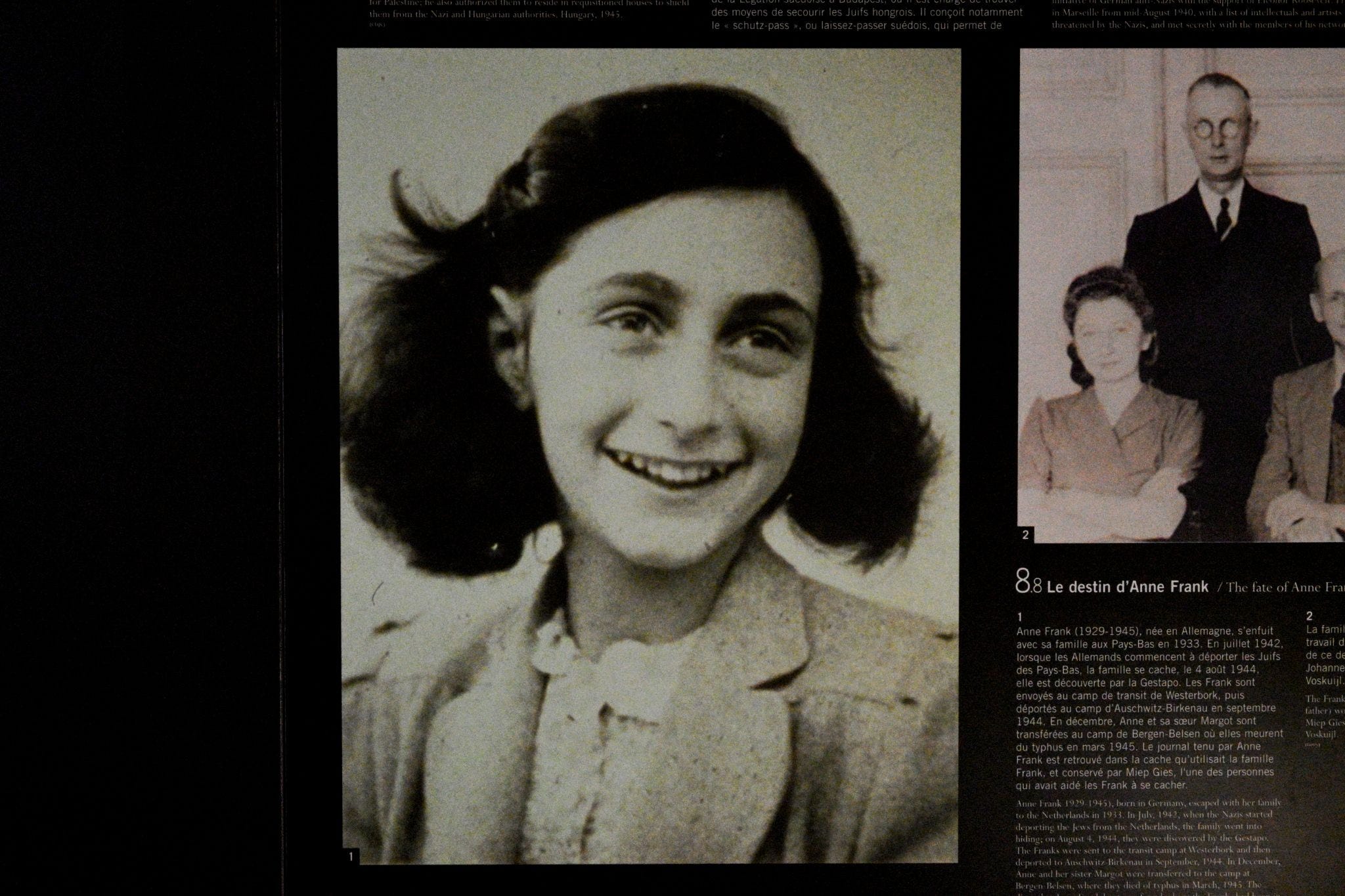
And it has been over two years since Anne Frank and her family went into hiding in a warehouse along one of Amsterdam’s canals to escape the Nazi regime and the ongoing Holocaust.
Alongside another Jewish family and a single Jewish man, the Franks were hidden away in a sealed-off annex of the building, where Anne would write her now internationally known diary, chronicling the daily struggles of their lives and her own personal reflections on the horrors of the war. The entrance to their hiding spot was concealed by a bookcase that functioned as a hidden doorway. Friends of Otto Frank, Anne’s father, smuggled in food and supplies at great personal expense. The Franks didn’t even flush the toilet during the day because they feared that any unusual noise might create suspicion and lead to their detection.
Not long after the Allies successfully invaded France in June of 1944, Anne wrote her last diary entry. An extremely perceptive person for her age (she was 15 at the time), Anne described herself as a “bundle of contradictions.”
“As I’ve told you many times, I’m split in two,” she wrote. “One side contains my exuberant cheerfulness, my flippancy, my joy in life and, above all, my ability to appreciate the lighter side of things. By that I mean not finding anything wrong with flirtations, a kiss, an embrace, an off-color joke. This side of me is usually lying in wait to ambush the other one, which is much purer, deeper and finer.”
Anne went on to observe that she is the kind of person whose words sometimes betray her true nature, hence her reputation as a “flirt” and “smark alec.”
“The happy-go-lucky Anne laughs, gives a flippant reply, shrugs her shoulders and pretends she doesn’t give a darn. The quiet Anne reacts in just the opposite way. If I’m being completely honest, I’ll have to admit that it does matter to me, that I’m trying very hard to change myself, but that I’m always up against a more powerful enemy,” she went on to say.
Three days later, the Nazi Gestapo discovered their whereabouts, acting on a tip from an unknown informant. Frank and her family were arrested, along with two Christians who had assisted and supplied them with food. The Nazis first sent them to a concentration camp in Holland, then to the infamous Auschwitz death camp in Poland.
As the Soviets advanced into occupied Poland in the fall of 1944, the Nazis transported Anne and her sister Margot from Auschwitz to the Bergen-Belsen concentration camp in Germany, where the conditions were horrifying and heinous. It was there that the sisters passed away after catching typhus in February 1945. Tragically, the British liberated this camp weeks later.
Otto was the only one to survive and later published his daughter’s diary in 1947, titled “The Diary of a Young Girl” in English. He passed away at the age of 91 in Switzerland.
Anne’s story showcases the very best and the very worst of humans. The fact that Anne and her family managed to survive for so long, with Anne expressing her personality, hopes, and dreams throughout her diary during such dark times, is a testament to their resilience and courage. That others risked their lives to help the Frank family shows that people are capable of acting selflessly in service of life, even when it entails the penalty of imprisonment and death. But that the Nazis were even able to rise to power in the first place, let alone carry out a brutal Holocaust that killed millions of innocents, shows that while some humans are capable of heroism and sacrifice, others are capable of terror and malice. That an anonymous tip led to the Frank family’s capture shows that some humans can be worse than cowards.
Like what you’re reading? If so, please consider subscribing to State of the Day or sharing this with a friend. You’d be supporting this newsletter and helping keep independent journalism alive.
If you are already a paid subscriber, make sure to join the conversation in our subscribers-only chat below.


