


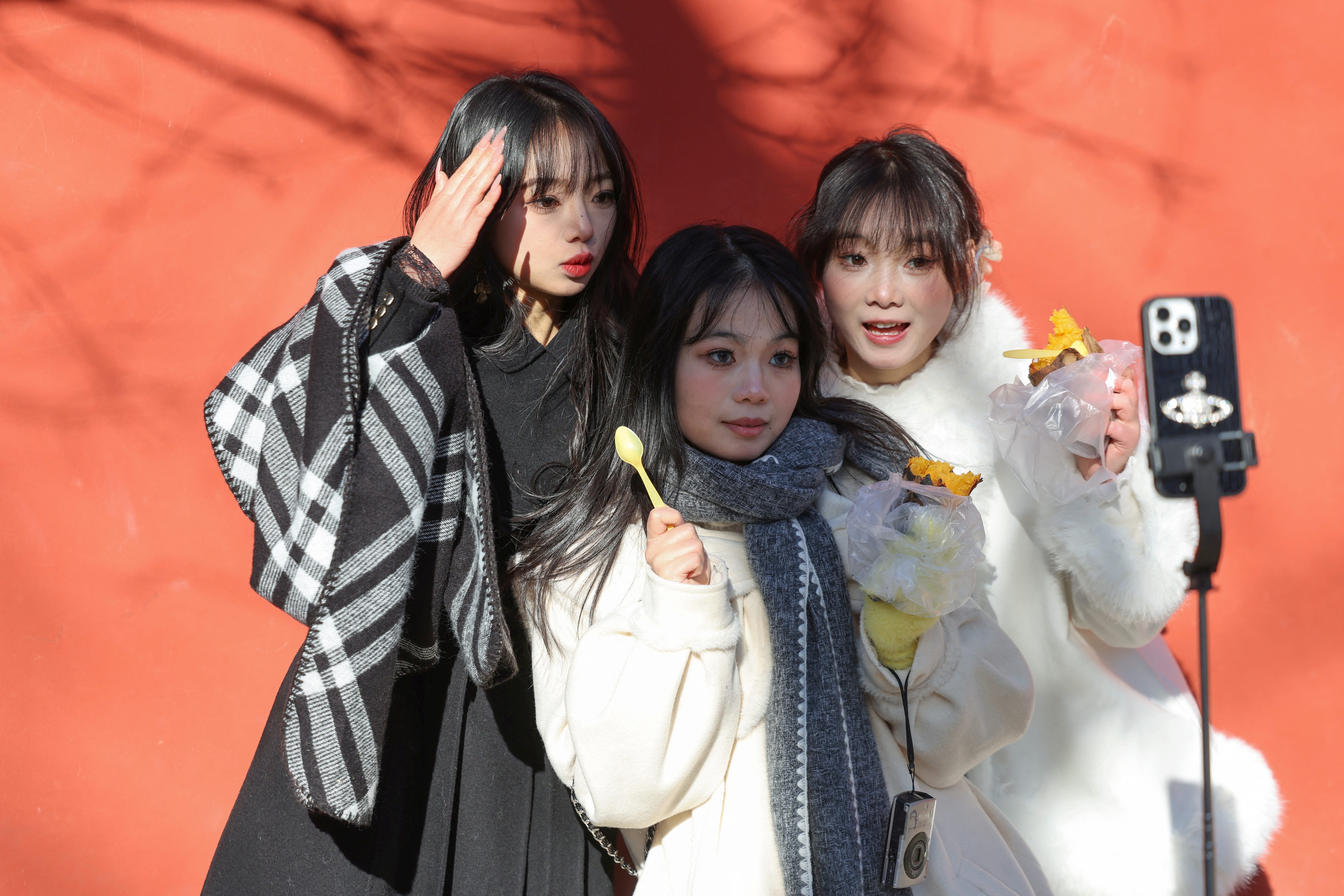
China has too many men and too few women willing to date them.
Consequences are always more obvious in hindsight. But the downstream effects of China’s one-child policy (1979 - 2015) don’t seem terribly tough to puzzle out. Quickly: When families only get one baby, they choose a boy. Especially rural families. When there are more boys than girls, girls have the upper hand in the dating market.
The New York Times (NYT) recently released a short documentary on a “dating boot camp” for China’s “30 million so-called surplus men.” We’re introduced to Wu, a 27-year-old delivery driver.
“Why aren’t you married? You’re in your late twenties,” Wu’s niece asks.
“No one wants to marry me,” he says.
“So work harder.”
Later, Wu reveals, “I work from 6:30 a.m. until after 9 p.m. For very little money. When I am not sleeping, I’m working. No time for dating. I’ve never had a real girlfriend, and I’m envious of others. When TikTok became really popular a few years ago, my feed was full of videos that teach you how to get a girl.”
Through Tiktok, Wu met Hao, a self-described “dating coach.”
“Most of my clients are defined as failures,” Hao says. “But they shouldn’t be deprived of love.”
We see Hao’s trainees getting haircuts and learning how to pose for photos.
“Infinite handsomeness,” he tells one of the men.
“Put your legs on the table,” he tells another, “Look arrogant.”
We see Wu “cold approaching” women in public, asking to add them on WeChat, only to be rebuffed.
“I grew up in a very poor rural village. I remember playing with friends along the road. We’d see abandoned baby girls. It was disturbing,” Wu tells the camera.
“Since all I interacted with growing up were boys, I know nothing about how women think and feel.”
“Given what society is like today, as an ordinary man, I can change nothing,” Wu says in the documentary.
And Chinese women, it seems, don’t want ordinary men.
YouTube is blocked in China (though this isn’t strictly enforced). Still, for a taste of a popular Chinese export, consider the YouTube channel “Asian Drama Junction.” The channel has racked up nearly half a million subscribers, and millions of views, summarizing Chinese (and Korean) romance dramas in Hindi. There’s a theme to the fantasies.

A lower status woman is plucked from obscurity by a higher status man, often a CEO, who happens to look like a member of an Asian boy band. If this sounds familiar: “Fifty Shades of Grey” was the best-selling book of the 2010s.
You may be thinking: “These stories are a little degenerate, but not civilization-ending.”
You are not a Chinese government official.
Chinese authorities are reportedly taking drastic steps to curb their “delusional female standards” crisis.
China’s National Radio and Television Administration has “released guidelines to regulate CEO romance micro dramas, emphasizing the need to avoid promoting ideals that glorify marriage with the powerful, wealthy individuals or families,” the Global Times reported Nov. 26.
“Additionally, they warned against the intentional creation of eye-catching content by flaunting wealth and showcasing power,” the outlet continued, citing Guangdianshijie, a WeChat account “affiliated with China Press and Publishing Media Group Co. Ltd.”
The term “domineering CEO” should be avoided.
“The creators should avoid wrapping absurd stories under the guise of realism and using absurd artistic techniques as an excuse to fabricate overly bizarre plots that lack genuine value, Guangdianshijie said, as such practices could distort the public’s perception of Chinese entrepreneurs and harm the profile of the entrepreneurial community.”
China’s primary concern is probably less for the reputation of entrepreneurs, and more for their total fertility rate.
Shenzhen, a Chinese city with a population hovering around 17.5 million, began offering cash rewards in 2023 to couples for having children, according to Sixth Tone. Sixth Tone is a Chinese state-owned online publication.
To receive more posts like this in your inbox, please consider subscribing using the button below.
“Families having a third child or more in Shenzhen will receive a cash allowance of 19,000 yuan ($2,825) in total until the child reaches the age of 3, according to draft rules released by the city’s health authority Tuesday. Those having their first and second child will be offered 7,500 yuan and 11,000 yuan, respectively.”
“Shenzhen has seen the number of births decrease for four consecutive years since 2017, with newborns in 2021 down 25% from the peak in 2017. Meanwhile, the number of married women of childbearing age in the city has declined for seven years in a row since 2015, the document said.”
Carrot, meet stick.
Pornography is illegal in China.
“The Chinese government has adopted a zero-tolerance policy toward so-called sexual content. Commonly defined as sexual, pornographic, and obscene material, the production, dissemination, and sale of such content, as well as other related behaviors, are forbidden under the law of the land. For the state, these crimes run counter to Article 24 of the Chinese constitution, which asserts that ‘the state strengthens the building of socialist spiritual civilization,’” law professor Chu Chenge writes for Sixth Tone.
In 2006, the creator of China’s then-largest pornographic website was reportedly sentenced to life in prison.
In 2018, a (female) Chinese author was reportedly sentenced to 10 years in prison for writing and distributing a novel which included homosexual acts.
“The popularity of homoerotic fiction, dubbed ‘boys love,’ has soared in recent years in China, where a booming cottage industry of self-published authors churn out hundreds of new titles each month,” CNN reported in 2018.
I’m sure some Chinese men are interested in homoerotic novels, but I’d wager Chinese women are the largest consumers of the genre. Again, a parallel in the West: Tumblr. The microblogging social media platform was mostly populated by women, many of whom spent their time fantasizing about gay men. Or willing straight male television characters to be gay.
That’s not to imply Chinese men aren’t interested in pornography (they are).
But there are specific pornographic materials which appeal to women, apparently crossculturally.
The United States government has not devoted serious attention to this matter, as far as I’m aware.
A smattering of Democrats, and significantly more Republicans, think too few babies are being born in the United States. Vice President JD Vance remarked, “I want more babies in the United States of America,” in a January speech at the March for Life.
But how do we get there? Our sex ratio is in better shape than China’s. That doesn’t matter much if young women and young men opt out of having children and forming families.
Much time has been devoted, especially among the Christian influencer crowd, to tut-tutting young men for watching porn. “Porn transforms the viewer from an active participant into a passive one.” True. “Porn is a surrogate activity.” True.
C.S. Lewis said it best.
Masturbation “takes an appetite which, in lawful use, leads the individual out of himself to complete (and correct) his own personality in that of another (and finally in children and even grandchildren) and turns it back; sends the man back into the prison of himself, there to keep a harem of imaginary brides.”
I wouldn’t deny any of those critiques. I would suggest that many of those critiques apply to female-targeted media, even those which are not gratuitously sexual (such as television soap operas). Those, too, are a kind of porn.
We know what terminal porn consumption looks like for men, thanks to a very detailed Harper’s Magazine report on “gooners.”
What does terminal romance consumption look like for women?
Probably: Kimi Onoda, Japan’s minister for economic security.
“[T]he possibility of getting married feels so utterly creepy to me … I don’t consider 3D (real-life) people as romantic prospects … it’s the same as if you were to suggest to a gay person that they marry someone of the opposite sex,” Onoda reportedly wrote, according to a translated version of her remarks.
“‘Hurry up and get married,’ ‘Have kids[.]’ I’ve been told this by voters since my 20s, but even at 40, I just sigh every time these words are thrown at me … I’ll say it over and over: I’m 2D-exclusive!!”
Onoda seems like a pretty great politician. But her love of country will be meaningless, if the Japanese people follow in her stead, choosing extinction.
We hope you enjoyed this article, and thank you for being a paid subscriber to State of the Day. Your support gives you exclusive access to premium content like this.
If you enjoyed reading, consider sharing this with a friend or gifting them a subscription. You’d be supporting this newsletter even more and helping keep independent journalism alive in the process.
And don’t forget to join our paid subscribers–only chat using the link below.
