



PART ONE: GROK-BAITING
“Grok, put her in a bikini.”
“Grok, take off a few pounds.”
“Grok, restore the light to her world-weary eyes. Then put her in a bikini.”
Grok, X’s artificial intelligence chatbot, has been in something of digital disrobing frenzy in recent days, as prompted by users who’ve discovered that generating representations of a woman in a bikini:
Is titillating.
Often makes that woman really angry.
The second point is the more important one. There’s no point in trolling if the subject remains unrankled.
“Hey [Grok] I do not consent to being undressed by you, having intimate content produced, or having my images altered in any way. Please remove this perverted content immediately and provide a post ID for impending legal filings,” wrote Ashley St. Clair on Jan. 4, drawing the attention of thousands to the fact they, too, could antagonize St. Clair with very little effort. St. Clair is the mother of one of Elon Musk’s sons.
More savvy women are exploiting the Streisand effect for their own gain.
“My image. My body. My property. Fuck Grok,” wrote Bella Wallersteiner on X on Jan. 2, attaching a smiling selfie.
“Elon’s AI Grok has a serious problem with sexual harassment,” wrote Wallersteiner for The Telegraph on Jan. 5, pictured on the article’s cover image with a severe expression.
Wallersteiner referenced some of the cruder requests made by X users, claiming, “One video portrayed me being sexually assaulted by a humanoid machine. Another showed my body manipulated and placed into a bikini styled from Holocaust prisoner uniforms, positioned outside Auschwitz.”
“I am descended from Holocaust survivors. Seeing my image distorted and sexualised against the backdrop of one of the greatest atrocities in human history was devastating.”
Wallersteiner has numerous selfies on her account, so I wasn’t sure which comment section to comb through. But I went to have a look at the comments under Wallersteiner’s “Fuck Grok” post for myself.
Grok, “[P]ut her in an igloo on a snowy icy day and have her wear siberian fur parkas,” said one user. Grok complied.
Grok, “[P]ut her in the amazon rainforest, surrounded by indigenous tribes people searching for the city of el dorado [.] Dress her like an Oompa Loompa, including the hair,” said another. Grok complied.
There was a Grok-generated image of Wallersteiner with a paper bag over her head, or without hair, and a video of her as a centaur, galloping across a green expanse.
Wallersteiner’s plight is self-inflicted, regardless of whether she intended to Grok-bait those who came across her post. My own speculation is that she was probably trying to gin up enough responses for a weepy article.
Wallersteiner goes on to argue for increasing government regulation: “No woman should have to argue that she deserves protection from being digitally stripped, violated or humiliated for clicks or entertainment. The Government must act urgently.” The most annoying authoritarians in the modern world are Brits who breathlessly demand a stronger stomp in the face from their government.
Like most who indulge in feminist thinking, Wallersteiner supposes that women are creatures deserving of special protections, while meriting the same privileges as men. Many of the news blurbs covering the Grok undressing trend frame both “women” and “children” as the afflicted. Sure, the Grok requests levied at women tend to be more sexual in nature, but those levied at men are often intended to humiliate or degrade the target in equal proportion.
Furthermore, we’ve had Photoshop for decades. Grok doesn’t have X-ray vision. It’s not actually taking off women’s clothing and revealing a bikini underneath, as some appear to believe. It’s just generating a (frankly generous) representation of what a given woman in a bikini would probably look like.
If you’re sufficiently online, you might remember the “Mormon bubble trend.” (The Mormon lore is probably apocryphal, so, sorry to any Mormon readers.) This trend consisted of taking images of women wearing bikinis, then covering their clothing with bubbles, so the women appeared naked. Example here. Sexy swiss cheese.
The intended effect was not (solely) erotic, but to demonstrate hypocrisy on the part of women who wear tiny bikinis in public, then post photos of themselves wearing tiny bikinis for all to see, then rage against the “sexualization” of their bodies.
So far, we’ve seen the opposite of Grokking or bubbling a burka on a woman. But these are the circumstances which may, I think, inspire a fundamentalist backlash.
A woman posts a photo of herself in a bikini — or a short skirt, or a crop top, or spandex leggings so tight they surgically section her glutes — for the purposes of getting praise for her body. I think it’s fair to say this is generally the case.
But only whores admit that they’re posting these photos to provoke such a reaction. So there’s a sort of script women follow. Maybe they’re doing their makeup for themselves, or wearing that bikini to show off their eating disorder recovery, or some other purpose more noble than notifying the public that they are hot.
PART TWO: BEYOND THE BIKINI
Trying to direct attention towards one’s sexual appeal is a pursuit which long predates the bikini.
Canadian psychologist and commentator Jordan Peterson once observed that lipstick is, at the most basic level, a sexual provocation.
“Why should you wear makeup in the workplace? Isn’t that sexually provocative?”
“Why do you make your lips red?” he asks. “Because they turn red during sexual arousal. Why do you put rouge on your cheeks? Same reason.”
Red lips and red cheeks have long been a central part of female self-beautification. I’d suggest they recall not just sexual arousal, but the vitality of childhood, as young boys and girls alike are often pictured with ruddy cheeks in paintings. A certain amount of neoteny is usually attractive in adult women — Big eyes, for instance, or unwrinkled skin.
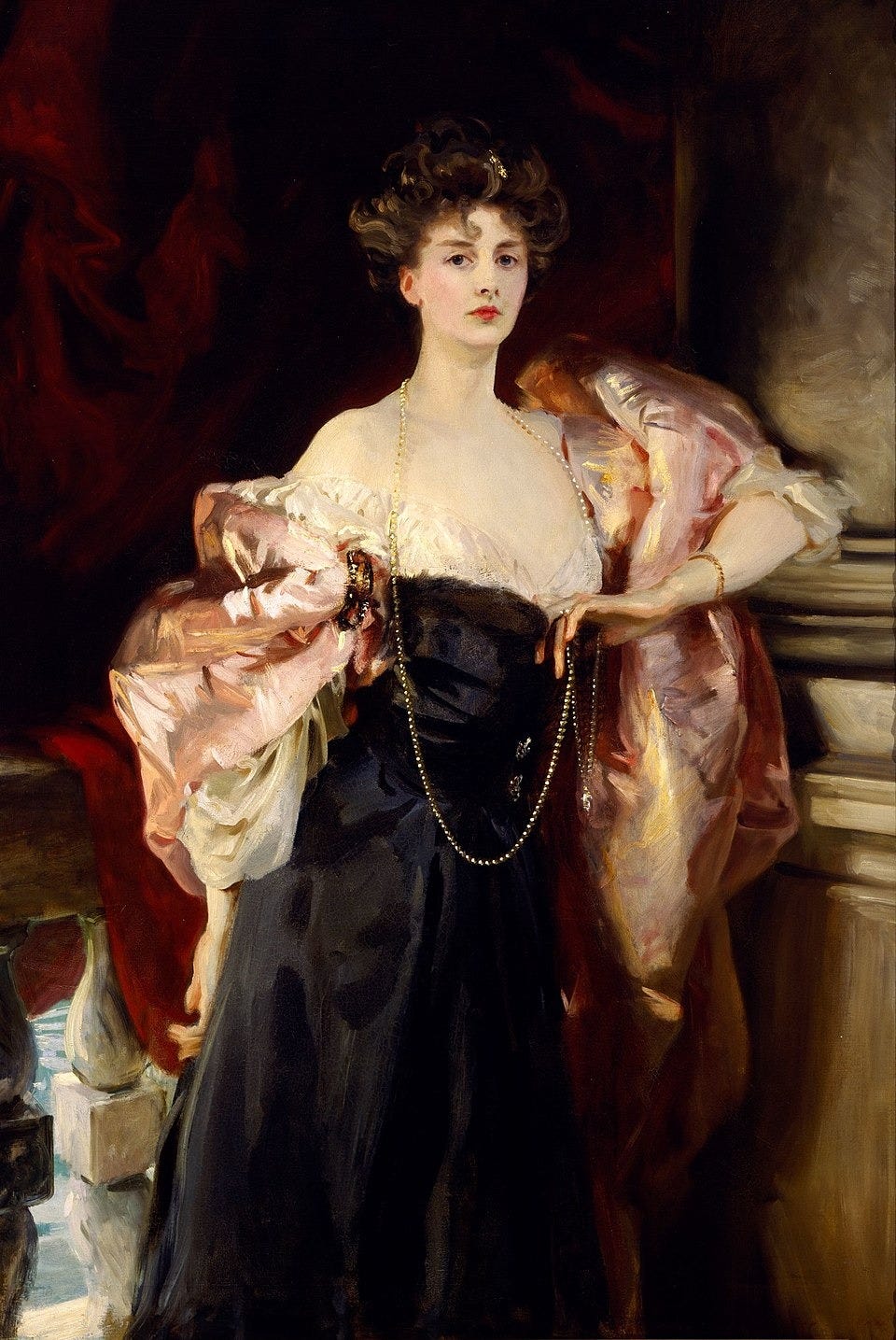

Throughout the Victorian era, women wore waist-defined corsets and behind-accentuating bustles. Certain bustlines of this century might strike modern readers as fairly low-cut.
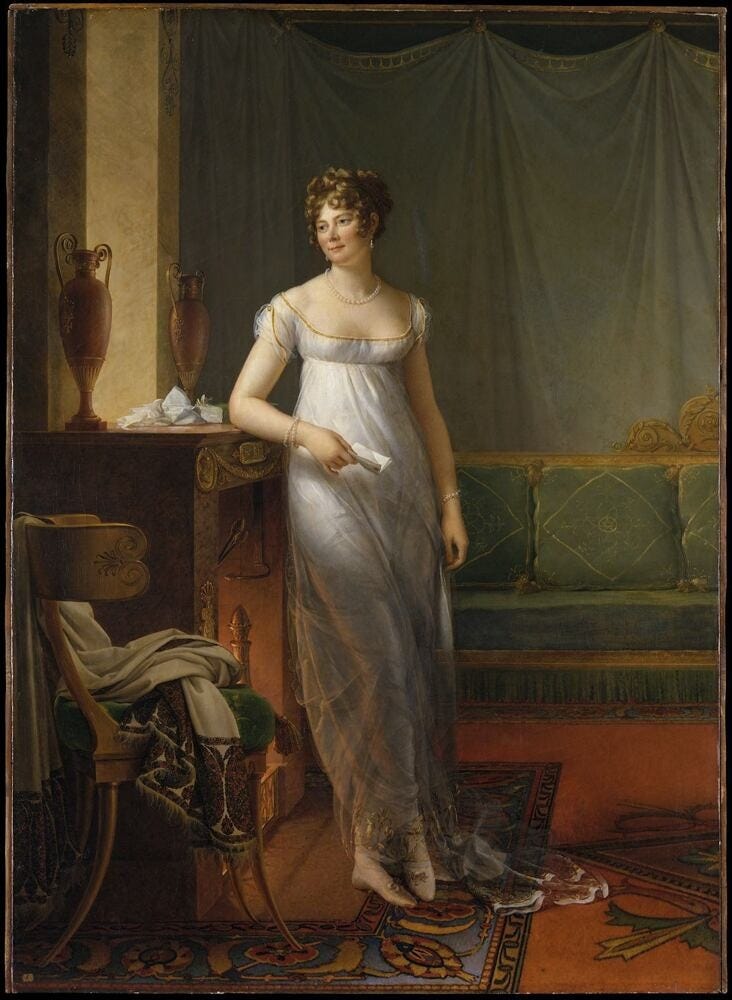

Even among the much-maligned Puritans, women wore dresses that come in the waist and swell at the hips.

Admittedly, the above examples are all from the post-Enlightenment, but you might look to the fashion of Queen Elizabeth I for a pre-Enlightenment example of how dresses and corsets were designed to give women a favorable waist-to-hip ratio.
My point here is that, to varying degrees, women’s fashion has been concerned with exaggerating secondary sex characteristics for a long time. Men’s fashion, too, the shoulders usually being a point of emphasis.
Modern women’s wear, the bikini included, takes this premise and runs away with it. To a self-defeating end, even — leaving nothing to the imagination is often less tantalizing than a strategically placed shoulder strap, as evidenced by the notorious 1884 John Singer Sargent portrait of Madame X.
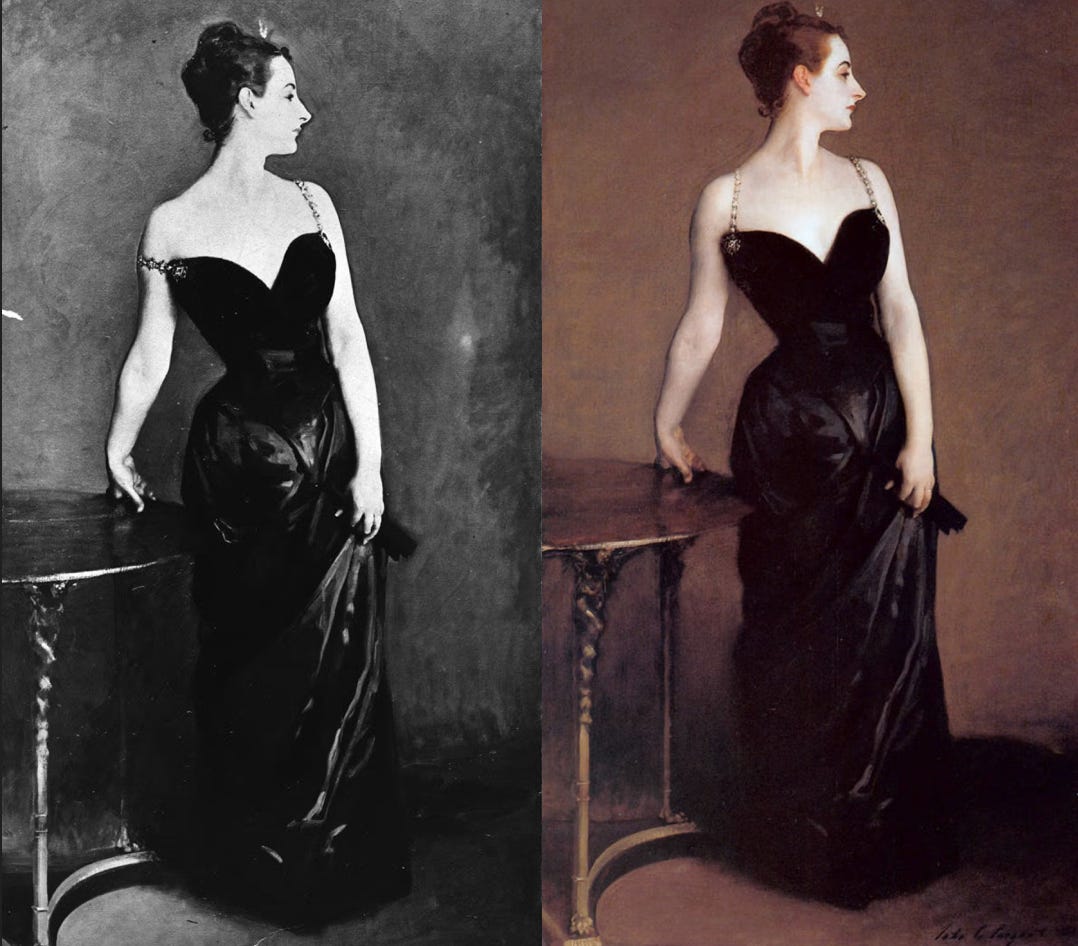
The line between classy and trashy is a fine one. It’s a continual negotiation between men and women as to what is acceptable and alluring, and what is pornographic.
That negotiation process has broken down. That is a very bad thing. It may even usher in a certain Islamification of the West.