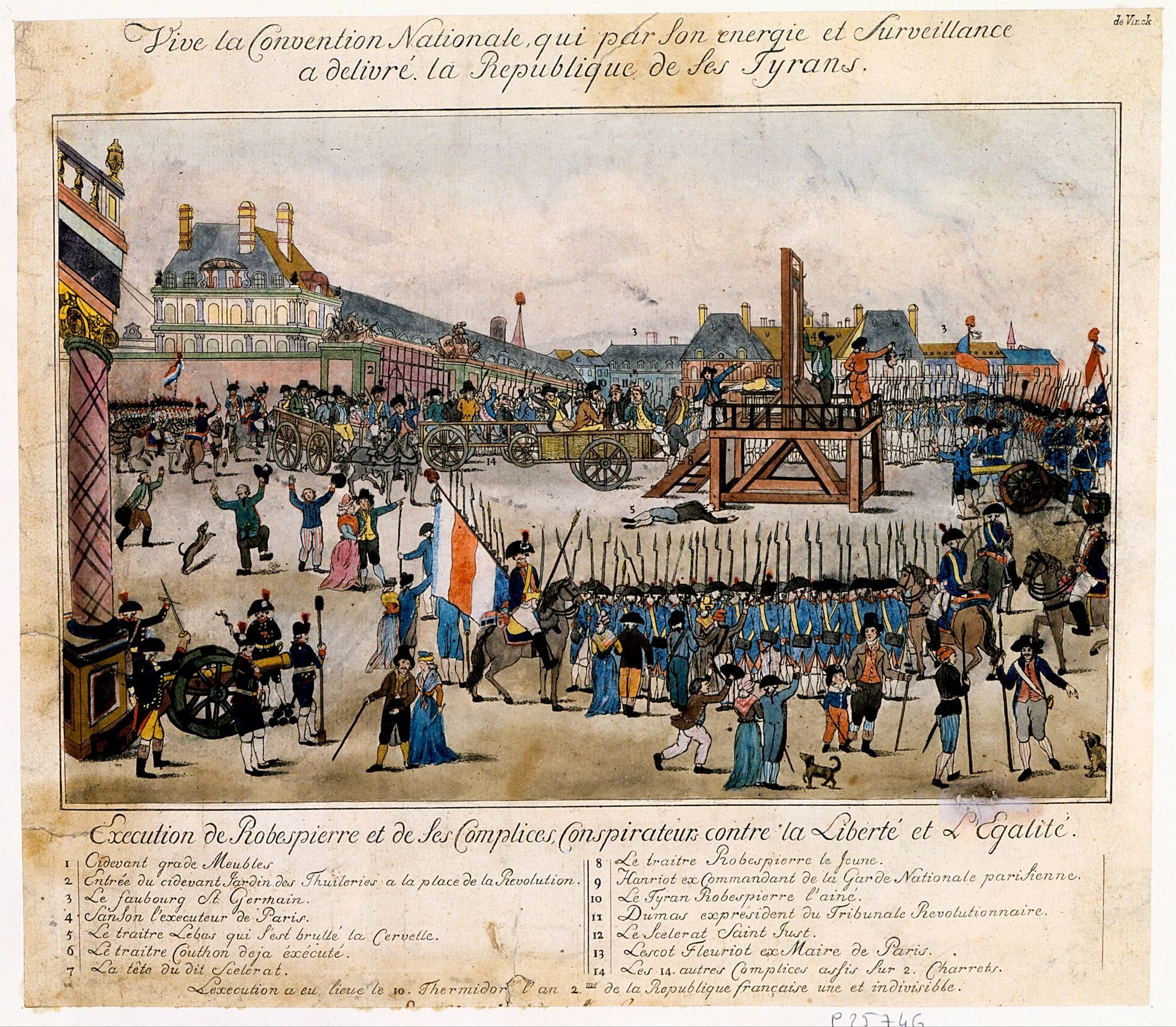
The year is 1794 …
And Maximilien Robespierre, a French lawyer and radical who is widely regarded as one of the most influential figures of the French Revolution, is about to meet his bloody fate – perhaps a fate he fully deserves. His rise and fall, and the most unsavory and barbaric aspects of the revolution, bear a striking resemblance to several modern American political figures and movements, as well as the general atmosphere of paranoia that has engulfed the country in 2026.
Born in 1758 to a lawyer and the daughter of a beer brewer, Robespierre demonstrated a great deal of talent and literary ability early in his life. He was fascinated by the ancient classics and the ancient world, deeply admired the Roman Republic, mimicked the rhetorical skills of Cato, Cicero, and Lucius Junius Brutus, and won a rhetoric contest in 1776 during his school years. He was academically gifted and studied law at the Sorbonne for three years. After passing the bar, he became a judge on a criminal court in 1782, but – in an ironic twist – resigned over ethical concerns stemming from his opposition to the death penalty.
By 1789, Robespierre had secured a position in France’s Estates-General, representing the French-Flanders region. At the beginning of the revolution, Robespierre closely associated himself with the Society of the Friends of the Constitution, a radical political club later known as the Jacobin Club (or simply, the Jacobins). He rose through the ranks and in 1792 was leading the charge against King Louis XVI, fervently pushing for his trial and execution. The Jacobins eventually overpowered another major faction of the revolution, the Girondins, who were appealing for clemency. The king was found guilty of the crimes of conspiracy and attacks on the “public safety,” and in January 1793, the revolutionaries sent him to the guillotine. It is believed that during Louis’ trial, Robespierre looked on from the front row.
This was the peak of Robespierre’s influence. From here, the revolution devolved even further into political infighting, paranoia, and ultimately terror and bloodshed. The country was on the brink of civil war as numerous aristocrats and federalists led uprisings in Lyon, Normandy, and elsewhere. After the assassinations of Louis-Michel Le Peletier de Saint-Fargeau, the revolutionary who cast the deciding vote in Louis’ execution, and Jean-Paul Marat, a Jacobin leader who was stabbed to death by a young woman as he lay in his bathtub, Robespierre lived in constant fear that he would be the next to die – and he had every reason to be paranoid. Marat’s assassin, Charlotte Corday, was only 24 years old when she committed the murder in July 1793. Corday detested the Jacobins, especially Marat, whom she believed was evil, and was sympathetic to the moderate Girondin faction. When asked during her trial how she knew to strike Marat’s heart, she swiftly replied, “The indignation that swelled my own showed me the place.”
Historians have debated the exact beginning of the French Revolution’s infamous “Reign of Terror,” but many point to September 1793 when the Revolutionary Tribunal began hearing more criminal cases against political opponents under the paranoid “Law of Suspects.” The Committee of Public Safety, established in early 1793, also played a monstrous role in fueling the revolutionary paranoia that swept through France. With broad administrative and spying powers, the committee acted as the state police, forming local networks to root out any perceived domestic enemies of the newly formed republic. Fears that foreign agents were working from within France to sabotage the nation and destroy the revolution’s “progress” worsened what was already a violent and chaotic time.
It is estimated that between 1793 and 1794, approximately 17,000 people were officially executed. Another 10,000 died awaiting their trials in prison, while tens of thousands were killed in unrecorded mass murders in regions that had rebelled against the revolutionary government. The preferred method of execution? The guillotine, which has since become synonymous with the French Revolution, as well as a symbol of the often violent, brutal nature of revolutions and their unintended consequences.
Along with the thousands of commoners and peasants who were convicted of sham crimes and sentenced to death by beheading, Robespierre would also face the music, eventually, in July 1794. At this point, dozens of members of the National Convention had been executed in the Reign of Terror, including the Girondin Georges Danton. Robespierre had turned on Danton after he called for moderation and the pace of terror executions to be slowed and ended altogether, pushing for his arrest and accusing the Girondin of corruption and treason. Danton also faced an unfair trial because Robespierre’s allies refused to allow witnesses to testify in his defense. He was executed in April 1794. All the surviving members now feared that others would turn on them and have them brought before the sham tribunal, as was the case with Danton, or else assassinated in their sleep. Several members feared Robespierre the most, as he was considered to be a particularly ruthless and vengeful man in the wake of Danton’s death.
But it came to pass that Robespierre would be the next Jacobin to receive his violent comeuppance. In what would be his final appearance at the National Convention in Paris on July 27, Robespierre was shouted down by his fellow members but lost his voice and could not muster a response. “The blood of Danton chokes him!” shouted one member, Antoine Marie Charles Garnier. Finally, Robespierre found his voice, yelling out, “Is it Danton you regret? ... Cowards! Why didn’t you defend him?” Robespierre and five of his deputies were later arrested, but managed to escape to the Hôtel de Ville. Accounts differ as to what happened next, but it is believed that as French soldiers stormed into the hotel, Robespierre attempted to commit suicide by shooting himself in the head. He failed, however, when a security guard intervened, instead shooting himself in the mouth. He also failed to escape.
By noon the following day, the Revolutionary Tribunal assembled and sentenced Robespierre and other Jacobins to death without a cursory hearing. They were carted off to the public guillotine, where an angry crowd gathered, hurling insults as they passed. A sketch attributed to Jacques Louis David depicts Robespierre on the day of his execution, with a bandage wrapped around his face and mouth to cover his gunshot wound and secure his broken jaw. Right before the guillotine drops onto his neck, executioner Charles-Henri Sanson rips off the bandage. Robespierre cries out in pain. The heavy steel blade plummets. His head rolls. And the crowd cheers.
It is an entertaining, if extremely bloody story, to be sure. But it also gives us so many valuable insights applicable to modern America.
First, as we celebrate 250 years since Independence Day, we should count our lucky stars that the American Revolution succeeded in the manner in which it did. It just as easily could have spiraled out of control, like the French Revolution, and devolved into chaos and terror. The Founders had their fair share of bitter disagreements. Still, it never reached the boiling point where they imposed violent tyranny on commoners while purging political rivals through hoaxes and sham trials.
Second, contrary to popular myth, the French Revolution was not a bottom-up rebellion waged against the king by farmers and peasants; it was very much driven from the top down. Robespierre is a prime example of how elites are usually the ones who trigger revolutions as they seek to usurp fellow elites — in Robespierre’s case, the monarchy and the clergy of the Catholic Church. In today’s world, look no further than caviar communist Hasan Piker, who wears luxury designer clothing while calling for America’s working class to seize the means of production, or members of the Democratic Socialists of America who have college degrees from top universities and Ivy League institutions but want to abolish police departments and even the U.S. Senate.
Finally, one way terror spread so rapidly through late 18th-century France was through accusations of treason and sabotage on behalf of foreign agents. This was a key smear tactic used by radicals to character assassinate their opponents, and, in some cases, get them literally assassinated. America is weathering a similar hurricane of paranoia surrounding foreign influence campaigns, commonly referred to as “ops.” “Ops” has probably become one of the most popular words in the political discourse, as “influencers”, pundits, and politicians use it to attack those with whom they disagree, rather than engaging with the substance of their arguments or policy ideas. Of course, foreign influence is a very real problem. On the right, there are, in fact, MAGA-aligned shills who are paid to propagandize for a foreign country. To say nothing of all the foreign money sloshing around Capitol Hill. However, this is a problem overshadowed by the countless – but ultimately baseless – “foreign op” smear campaigns waged by the hivemind of commentators and operatives jockeying for attention and political clout.
Karl Marx famously believed the first French Revolution was a tragedy, but the second, the 1848 coup led by Napoleon’s cousin Louis-Napoléon Bonaparte, was a farce. If a coup in 1848 was considered farcical then, whatever sort of revolution is in the air in America in 2026 is uber-farce – a giant, raving carnival of social media clowns. But that is not to say it can do no harm to the country. Speaking for myself, I find clowns terrifying.
Like what you’re reading? If so, please consider subscribing to State of the Day or sharing this with a friend. You’d be supporting this newsletter and helping keep independent journalism alive.
If you are already a paid subscriber, make sure to join the conversation in our subscribers-only chat below.


It would appear that Robespierre was opposed to the death penalty until he was for it. Or maybe his opposition was just centered around who the penalty would be applied to?
