


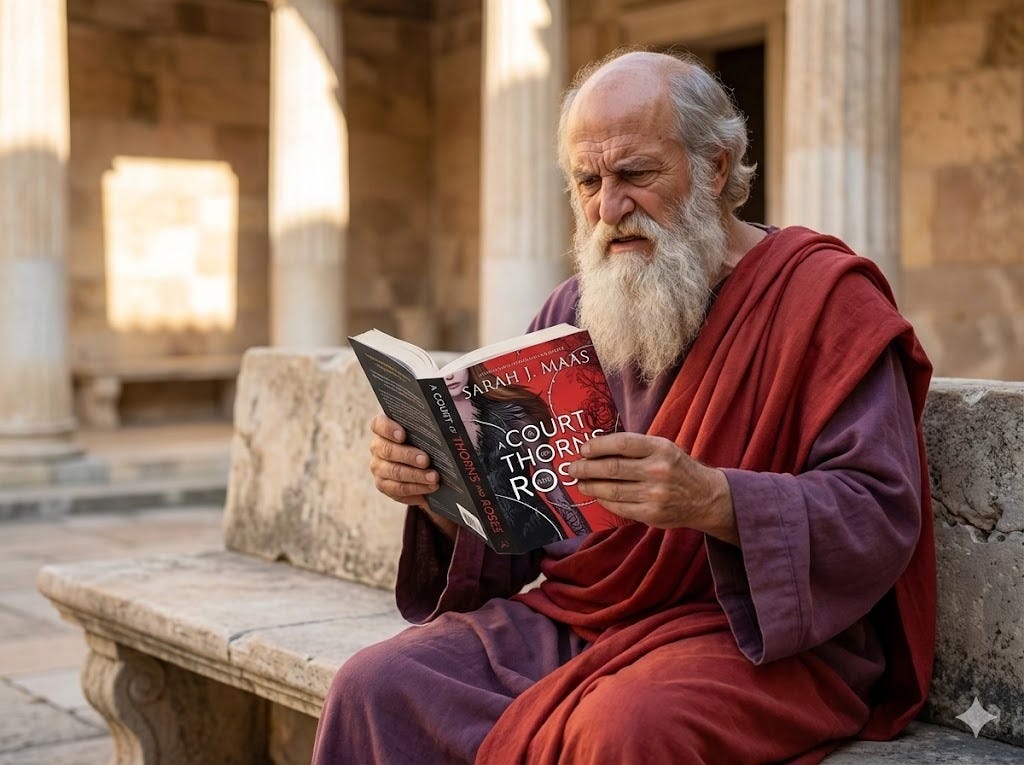
I. AN INTRODUCTION TO BOOKTOK
BookTok is a TikTok sect which emerged around 2019 or so, growing in popularity during the COVID-19 lockdowns. Members of BookTok are mostly young, mostly female. They make and consume videos concerning: book reviews, recommendations, “hauls,” and general fawning over trendy titles. BookTok favors young adult fiction and so-called “romantasy.” The latter is often extremely sexually explicit.
A few BookTok approved reads I discovered in the course of my research:
“A Court of Thorn and Roses” (fairy smut)
“Fourth Wing” (dragon rider smut)
“Ice Planet Barbarians” (ice planet barbarian smut)
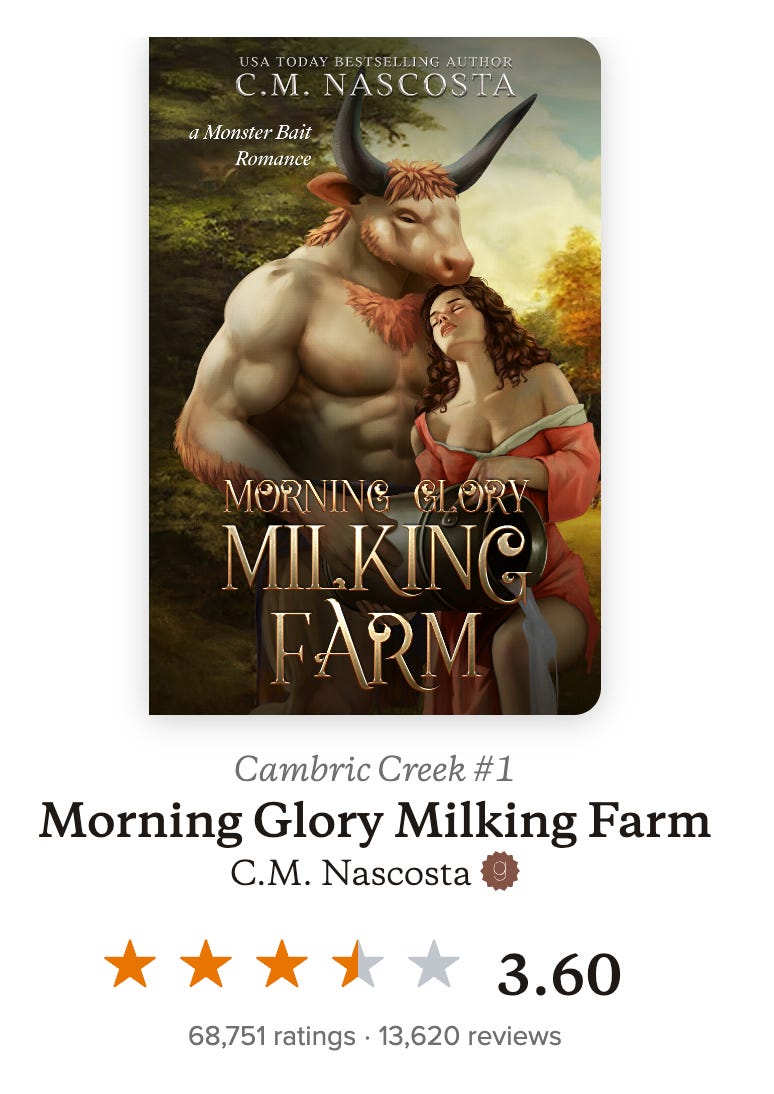
“Morning Glory Milking Farm” (take a wild guess)
BookTok is popular. The “hashtag #booktok had over 38 million posts with more than 309 billion views” as of October 2024, according to The University of Melbourne’s Pursuit. Books which proliferate on BookTok see massive sales. “Heated Rivalry,” a smutty book series about gay hockey players, was recently adapted into an HBO Max show. “It has remained in HBO Max’s Top 10 shows, racked up millions of interactions and mentions on social media, and driven such high demand for the book that physical copies are out of stock on Amazon,” claims Rolling Stone.
I hate BookTok, and you should too, because BookTok offers a depraved moral education.
When I refer to “education,” I don’t mean debating the merits of Common Core or rote memorization or charter schools. When I refer to “education” I mean: The shaping of the soul. Developing a man’s potential. Orientating that man towards wanting and doing good.
With that end in mind: How do we get there?
II. WHAT IS POETRY?
A good deal of moral instruction comes to us via poetry. Poetry, as defined by Socrates in Plato’s “The Republic,” is the art of imitation.
There are three forms of poetry.
Simple narration (diegesis): The poet speaks in his own voice. In this view, a politician’s speech is poetry, as is a memoir, as is a sonnet told from the writer’s perspective.
Imitative narration (mimesis): The poet speaks in another’s voice. In this view, William Shakespeare’s plays are poetry, as are romance novels, as is “Goodnight Moon.” All fiction is mimesis.
Some combination of simple and imitative narration.
Imitative narration is the most dangerous kind of poetry, because the poet conceals himself via character. The reader or listener or watcher of imitative narration develops a sort of pleasant amnesia called “suspension of disbelief.” Hamlet becomes a real man in the dark of the theater, Shakespeare’s machinations temporarily forgotten.
III. THE PROBLEM OF POETRY
You’ve been promoted. You’re now Education Czar of an imagined Republic. Congrats!
You have nearly unlimited power, with one caveat. The Republic is guided, above all, by the virtue of justice. Any policy you propose must encourage individuals to maximize their potential, serve others, and live in harmony with universal truth.
Easy enough. So, where do you start? How are you going to promote virtues in your citizenry? And where does poetry fit into all this?
Socrates has some advice.
Some tales “are to be told, and others are not to be told to our disciples from their youth upwards, if we mean them to honor the gods and their parents, and to value friendship with one another,” says Socrates in Book III of The Republic (trans. Benjamin Jowett). When I refer to Socrates, think, “Socrates of ‘The Republic.’”
In order to raise up men who are “fearless of death,” the we must “assume a control over the narrators of this class of tales as well as over the others, and beg them not simply to but rather to commend the world below, intimating to them that their descriptions are untrue, and will do harm to our future warriors.”
To that end, poetry is to be ruthlessly edited (censored) for passages which might inspire fear of death. If we apply this standard to the novel, we must ruthlessly edit out those passages which inspire corrupt desire.
We “must beg Homer and the other poets not to be angry if we strike out these and similar passages, not because they are unpoetical, or unattractive to the popular ear, but because the greater the poetical charm of them, the less are they meet for the ears of boys and men who are meant to be free,” says Socrates, offering a list of objectionable passages from works such as the “Iliad” and the “Odyssey.”
“Another and a nobler strain must be composed and sung by us.”
An education, in this view, is the formation of character. Ethos. The function of civil society is to make men who are good and who do good.
Contrast this ethos-education with our education system which, if it has any goal at all, aims to make “informed” citizens of the young. (There are secondary and unspoken aims — to instill obedience in the young person, to accustom him to life in a cubicle or a prison cell, to inspire in him an unthinking but absolute belief in regime orthodoxy.)
But the stated aim of many teachers is to simply get their students to retain a factsheet about the world, then use those facts as they like.
Some teachers, usually those at private schools bankrolled by anxious upper-middle class parents, claim they are “not teaching their students what to think, but teaching them how to think.” This involves teaching the child to examine his own beliefs — not unlike a Socratic dialogue. But the teacher confuses “thinking” for an end, where, in Socrates’ view, it is only a means to an ultimate good. Should this teacher’s students arrive at a variety of conflicting conclusions, the teacher believes his job well done, so long as all conclusions were hard-fought.
More honest teachers — idealogues — have a particular, often malformed, concept of the “good” they aim to inculcate in their students.
Socrates’ ethos-education sounds pretty agreeable at first glance.
But, John Milton might object, “I cannot praise a fugitive and cloistered virtue, unexercised and unbreathed, that never sallies out and sees her adversary, but slinks out of the race where that immortal garland is to be run for, not without dust and heat.”
So the solution becomes clear. We must educate boys into virtuous men. We will do this with the help of “moral” poetry. We will burn any book which might lead the boys astray. We will slice and stitch back together the great epics, expurgating any hint of cowardice or immoderation. Then, when our pupils have built up a sufficient resistance to the temptations of the world, permit them some exposure to that world.
IV. SOME CAVEATS
Now, to undermine Socrates’ authority. (Get excited, BookTok advocates!)
Earlier, I mentioned that imitative narration — in which the author speaks in another’s voice — is the most suspect form of poetry. You may have noticed that Plato is himself an imitative poet. I’ve attributed certain propositions to “Socrates,” when in fact, I’m referring to the Socrates of Plato’s imagination. And the Socrates of Plato’s imagination makes reference to all sorts of concepts which might inspire moral waywardness in the reader, and so, we should ask, should “The Republic” be burned? Censored? Locked up in a secret vault, only accessible to Philosopher-Kings on their 40th birthdays?
I don’t think so, but it’s something you might consider.
In any case, I don’t think we have to dismiss Socrates’ propositions because they may not align with Plato’s.
Socrates does not have in mind the education of the entire Republic. Higher education of the virtue-inculcating sort is to be restricted to a small subset of men, who will one day become the philosopher-guardians of the city. Those that have (potential) shall be given more (resources).
If we’re going to accept Socrates’ educational model, we’re going to have to tailor it to whatever population we have in mind. In this case: BookTok women.