


I recently watched for the first time the 1995 Las Vegas mob movie, Casino, starring Robert De Niro as a plucky but obsessive and pernickety casino manager, the inimitable, funny, oddly frightening Joe Pesci, and model-turned-actress, 90s starlet Sharon Stone, who plays the perfect role as a trophy wife destroyed by drugs, alcohol, narcissism, and a loser ex. Considering that I love Martin Scorsese and think he’s one of the best filmmakers, if not the best filmmaker, to have ever lived, shame on me for not having seen Casino earlier in my life! It is darkly comic, tragic, violent, a classic rise-and-fall storyline – a pure Scorsese masterpiece.
But all of the great scenes, lines, cuts, and clever use of voiceover, it was the very ending of Casino that hit me like a cinematic freight train. I just sat there, mouth agape, watching credits fade in and out, trying to process what I had just witnessed. It was actually haunting, and the J.S. Bach credits music was so beautiful, and I didn’t want it to end. It’s one of those rare movies that makes you wish you hadn’t seen it so you can go back and relive it for the first time.
So if you haven’t seen the movie, don’t worry: I won’t spoil it. All you need to know is that a key character is looking back on his life, reminiscing about Las Vegas – the old Las Vegas – and the way the town used to be run. When the city was a little grittier and rougher around the edges, but far more fun, authentic, and personable. “In the old days, dealers knew your name, what you drank, what you played,” he says. “Today, it’s like checking into an airport, and if you order room service, you’re lucky if you get it by Thursday.” And then this character laments how big corporations swooped in after the demise of the Teamsters unions, demolished all the historic casinos, erected the new ones we associate with Vegas today, and sanitized the city, turning it into a Disney world for adult tourists, whom the character describes as “whales” with suitcases.
“Where did the money come from to rebuild the pyramids?” he asks, referring to the Luxor Hotel, which opened in 1993. A pause. “Junk bonds.”
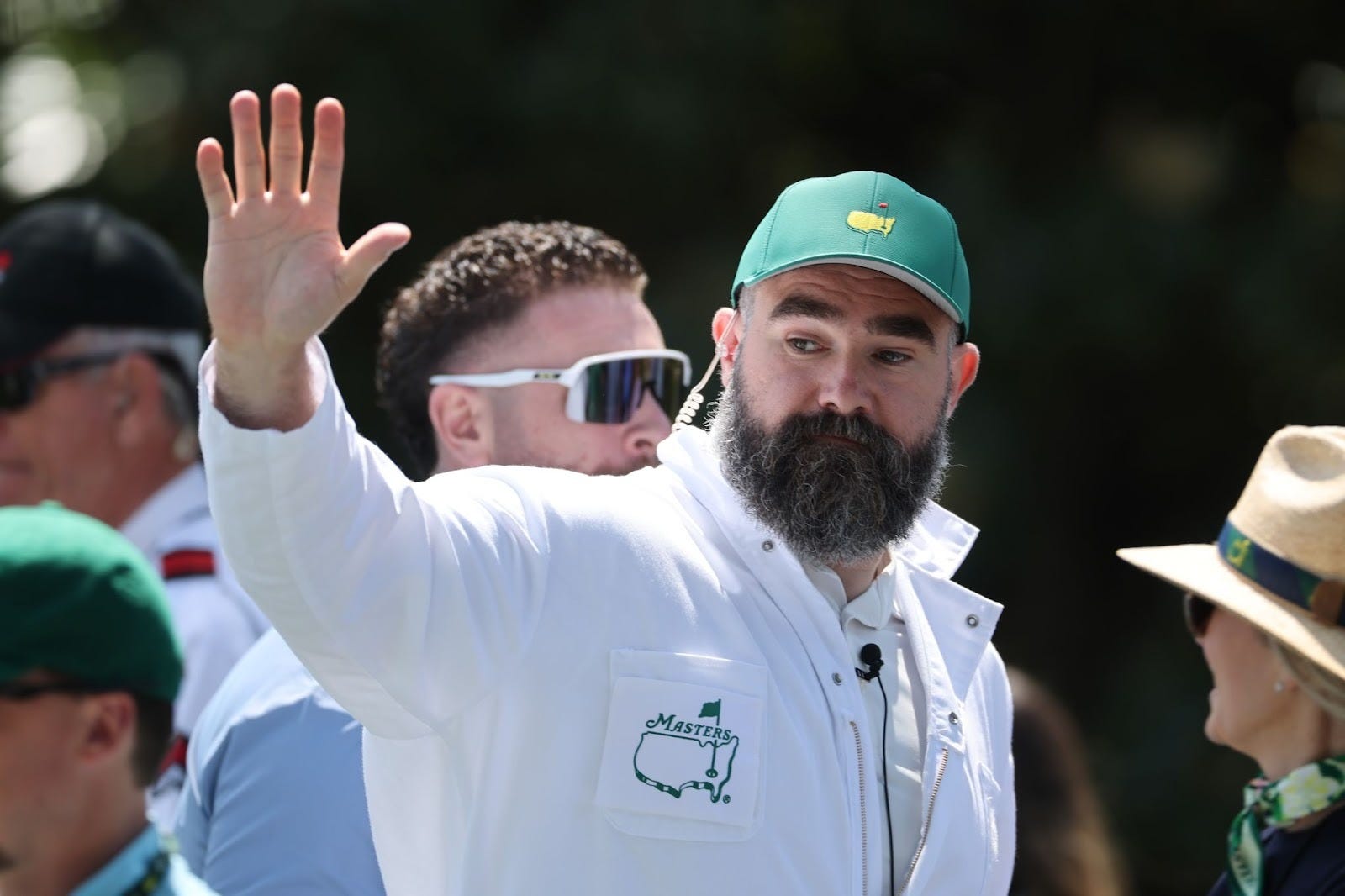
Okay, so how could this possibly tie into the Masters? Well, there’s been much online chatter in recent days about how the Masters is being turned into something that it is not: a cheap, coarsened, charmless, commodified spectacle that isn’t so much about the hallowed game and traditions but about money, more money, and generating content that goes viral on social media. With appearances at the Par 3 contest on Wednesday from former Eagles legend and celebrity Jason Kelce, as well as mega-famous movie star Kevin Hart, the Masters traditionalists were low-key irate. Some were calling it the “Barstoolification” of the Masters, a reference to Barstool Sports, whose brand has this dirt-bag, frat bro, party animal style to it. There were also criticisms of the merchandise, particularly the hats, which, in my humble opinion, are ugly, gauche, and kind of corporate minimalist, but are apparently popular among young bro golfers and influencers.
I’m not here to bash capitalism. But I think it is undeniable that there are downsides to every system – well, socialism and communism are just pure downside – and I think people on the right get a tad squeamish when it comes to acknowledging things that are, how do I put this, off(?) about our current system. Like, if I were to say that Wall Street and private equity groups should be banned from consolidating companies that make fire engines and equipment, which leads to higher prices, supply chain bottlenecks, and leaves small departments totally out to dry, some people on the right would yell, “You can’t say that! That’s an attack on the ‘free markets’!” No, I simply think there are downsides and trade-offs to literally everything in life, and though capitalism has brought unprecedented material abundance and wealth to America and is, almost, perfectly imperfect – like our Constitution – that does not mean it can’t do any harm.
These trade-offs are being made apparent at the 2026 Masters. Historically, the Masters was very exclusive to both players (the field is small relative to other tournaments), as well as fans, who must win a lottery just to be able to have the opportunity to buy a ticket. In this way, it sets itself apart from other major tournaments, which are also exclusive but maybe not quite as exclusive as the Masters. It’s at the same pristine course every year, for example. There are strict no-phone rules. You cannot run. You cannot sit directly on the grass. You cannot wear backwards hats or denim. Of course, many tournaments have strict rules, as well, but there is something about the Masters that feels almost over-the-top in the best possible way. Augusta is like a sanctum of tradition. The exclusivity, the traditions, and the old-school, Southern clubhouse feel add to its charm.
But this year’s critics are correctly fingering the issue: the Masters is beginning to feel less and less like a very prestigious and historic golf major, and more and more like a spectacle infiltrated by a culture that doesn’t really respect what made it so great in the first place: the traditions that have spanned generations. Kind of makes me think of … mass illegal immigration? Heck, even Augusta National Chairman Fred Ridley practically admitted as much, saying Wednesday it was probably a bad idea to let a group of famous YouTubers play disc golf at the famous Amen Corner in 2023. I think he’s right.
If the Masters were to loosen up the rules even more and allow the hordes of influencers and content-generating celebrities like Kelce and Hart to play bigger roles before or during the tournament, that right there would be a goldmine. More viral content = more ads. More ads = possibly more dollars. Imagine if they allowed Kim Kardashian to walk around the course on Masters Sunday, taking selfies and posting Instagram vlogs. Imagine if they invited Mr. Beast, the wildly popular YouTuber known for his viral stunts and “challenge” videos, to play in the Par 3 contest, but also perform a challenge at the Amen Corner with several pros, and then have him plug the PGA and all of the tournament’s corporate sponsors. The corporations would be giddy, as would the Big Tech companies on whose platforms the content goes mega viral. This, of course, would be a bargain with the devil. The tournament would be more profitable, but its soulful authenticity would be destroyed in the process.
And to be clear: I’m ripping on corporate capitalism (if you can even call it “capitalism”), not all the wonderful, smaller companies and businesses that keep America’s economy chugging on all cylinders, and its citizens gainfully employed. I’m not ripping on the mom-and-pop venture that makes the pimento cheese featured in the $1.50 Masters pimento cheese sandwich; I’m ripping on the Big Food corporation that will end up buying that family company and then swapping out the original, delicious recipe with fake garbage ingredients that ultimately ruin the product, just so they can save a couple bucks. I’m ripping on the corporations in bed with federal regulators, the behemoths that lobby Congress to pass laws that strangle competition and give them unfair advantages. Mom-and-pops don’t have the power to bend politicians to their will; corporations do.
Maybe the trend that has disturbed many a golf fan in recent years – the complete and utter destruction of golf etiquette and tradition – will continue apace, and we will look back at the Masters, like the character in Casino lamenting his lost Vegas, and reminisce about the days when the tournament was still pure and authentic.
“Where did the money come from to rebuild Augusta? … Algorithms.”
Like what you’re reading? If so, please consider subscribing to State of the Day or sharing this with a friend. You’d be supporting this newsletter and helping keep independent journalism alive.
If you are already a paid subscriber, make sure to join the conversation in our subscribers-only chat below.

Now I wanna watch Casino!
Used to work for a Fortune 500 entity. What they were best at was laying off their employees.