


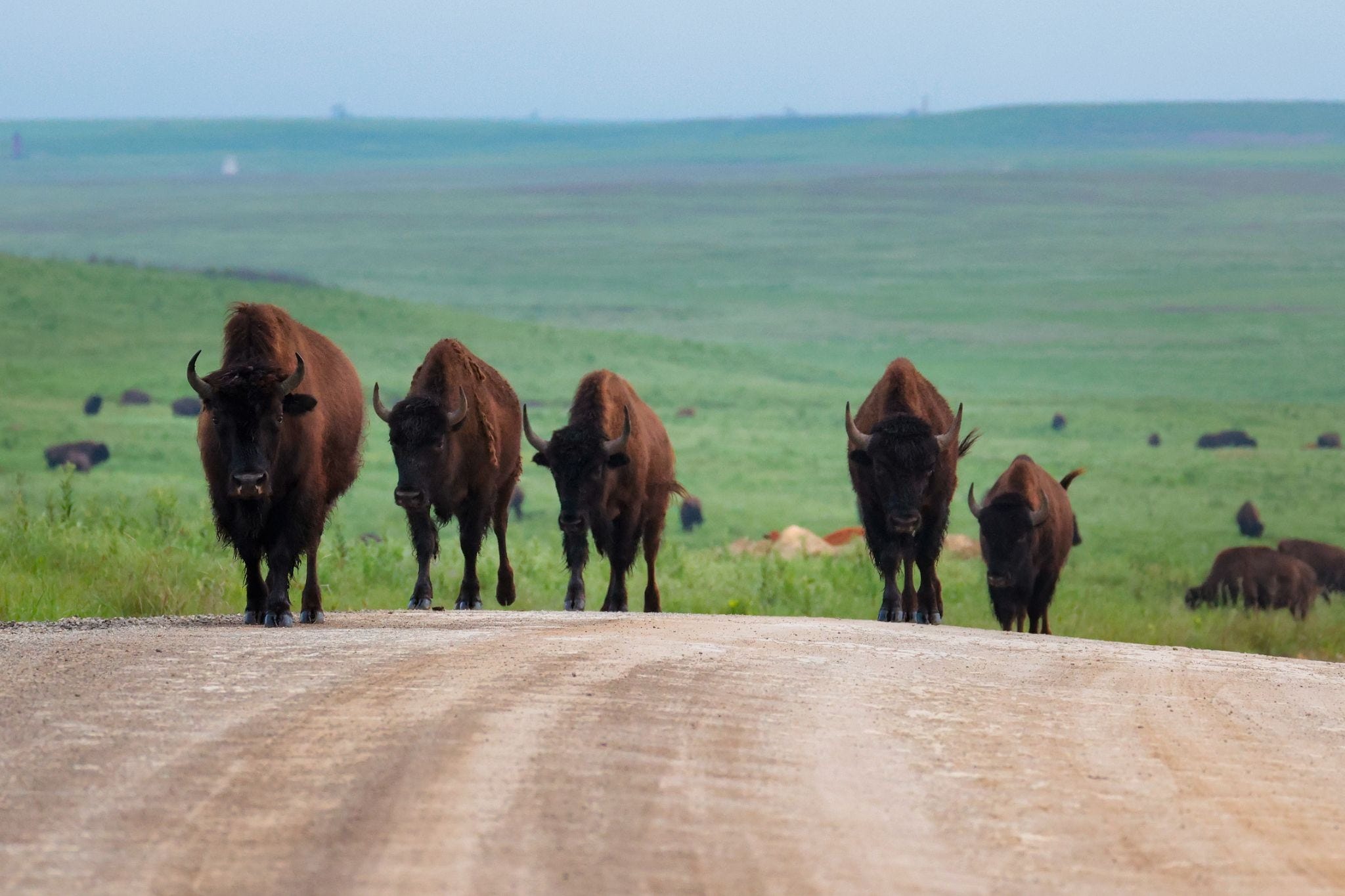
Hundreds of years ago, millions of bison freely roamed North America.
By the end of the 19th century, however, bison went nearly extinct in the United States. Years of overhunting, the rise of an international market for bison hides, further westward expansion, and the “Great Slaughter,” backed by the U.S. government and lasting from 1820 to 1880, reduced millions to an estimated 1,000 animals. Since then, recovery and conservation efforts have helped the bison population rebound to between 400,000 and 500,000.
Over 900 of these bison graze on a vast stretch of federal public lands along the Missouri River in North Central Montana, under the stewardship of American Prairie, a nonprofit organization whose ultimate goal is to create a sprawling wildlife refuge in the Great Plains region. The organization says that, unlike National Parks created by the federal government, it uses “a public-private partnership model that stitches together fragmented public lands through the purchase of private lands.”
As part of its effort to “rewild“ the Great Plains, American Prairie has managed a herd of free-roaming bison since 2005, aiming to increase the herd to 5,000. The organization monitors the bison for diseases and tags them for identification. They also allow many of the bison to be used for public consumption and run an annual public hunting program, which has produced approximately 75,000 pounds of meat from some 370 bison since 2016.
A crucial part of their restoration process is grazing permits granted by the Department of the Interior’s Bureau of Land Management (BLM) that allow the organization to graze the herd on federal public lands.
But a legal fight has exploded in recent months, pitting cattle ranchers and the BLM against American Prairie and other conservation groups. The outcome could determine the fate of hundreds of bison and have sweeping consequences for the region and its inhabitants, human and animal alike.