“Neither will I administer a poison to anybody when asked to do so, nor will I suggest such a course. Similarly I will not give to a woman a pessary to cause abortion. But I will keep pure and holy both my life and my art … Now if I carry out this oath, and break it not, may I gain for ever reputation among all men for my life and for my art; but if I break it and forswear myself, may the opposite befall me.“ - The Hippocratic Oath, trans. W.H.S. Jones
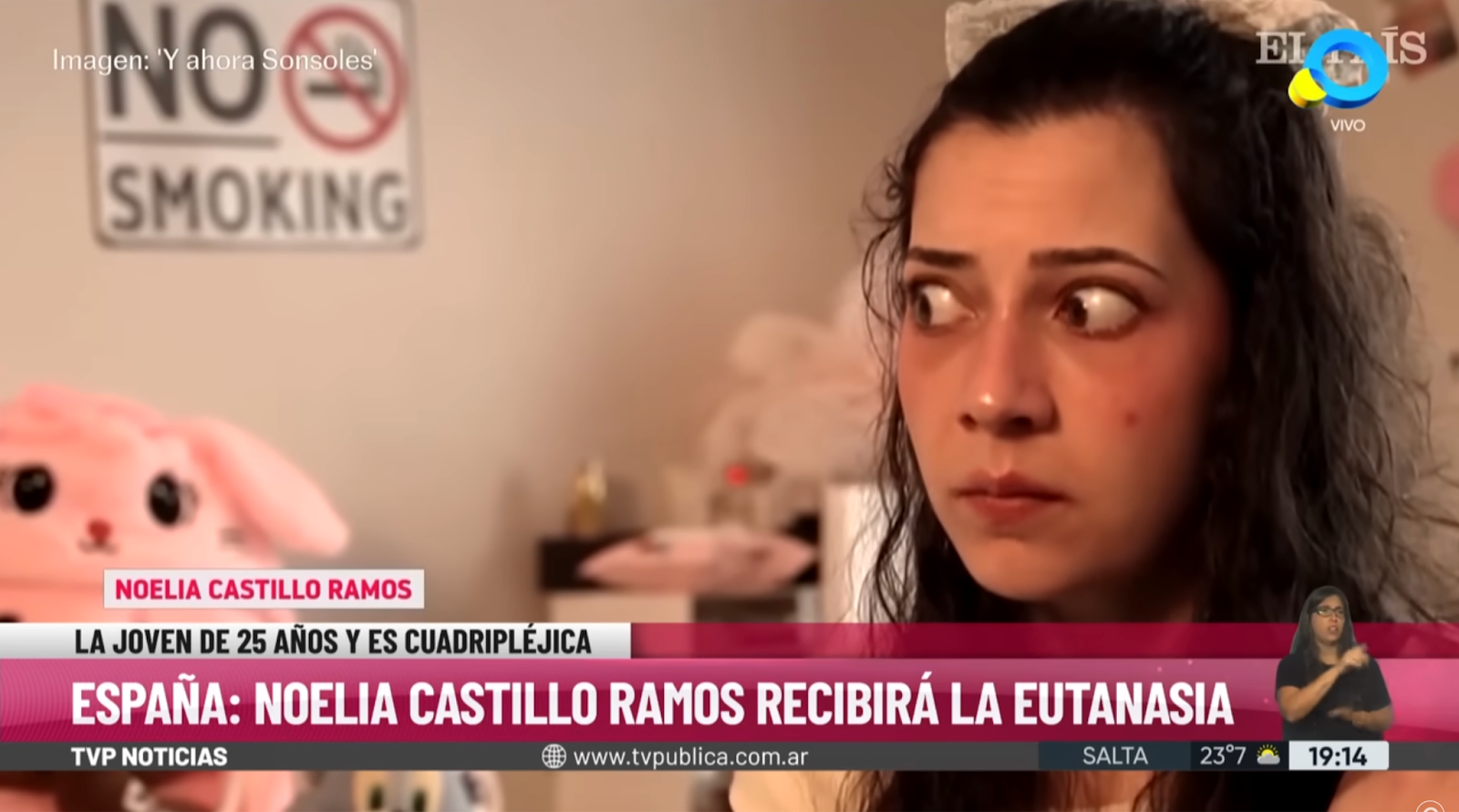
Noelia Castillo Ramos, 25, died today.
She reportedly hoped to wear her “prettiest dress” to the occasion.
Ramos attempted suicide in 2022 after she was gangraped, leaving her paralyzed and dependent on a wheelchair. She died the European way — state-administered suicide. Spain has a streamlined method of putting down their people. First, a healthcare professional sedates the patients with lidocaine and midazolam. Then the patient is injected with a coma-inducing drug (propofol) and neuromuscular blockers (atracurium, cisatracurium, or rocuronium).
The Spanish Ministry of Health’s “Manual Of Best Practices in Euthanasia” details the specific doses of each drug “necessary to achieve the desired effect in 95% of the population.” The Spanish Ministry’s desired effect, or “primary objective,” is to “ensure the patient’s death in the shortest possible time.”
When the patient is good and dead, a team of surgeons may rush in to collect the body’s precious organs. The surgeons must work quickly. Without blood supply, the heart will deteriorate to the point of uselessness in a matter of hours.
Organ donation may be a motivating factor in the state approving Ramos’ euthanasia. I’ll return to this later.
“None of my family are in favor of euthanasia,” said Ramos in Spanish during a recent, final interview, according to El Confidencial.
“I am a pillar of the family. I am leaving them suffering. But what about my suffering? The happiness of a father, a mother, or a sister shouldn’t be more important than that of a daughter or the life of a daughter.”
Ramos was born into a “dysfunctional family,” according to Spanish language newspaper El País. The state reportedly took Ramos from her parents’ home as a child, leaving her in the care of various children’s homes.
Ramos “said she was raped on two occasions, once by her ex-boyfriend and the second time by three boys in 2022,” reports Sky News.
The gang rape occured while Ramos was living in a “state-supervised centre for vulnerable youth,” according to LBC.
The names of Ramos’ attackers have not been made public. Members of Spain’s right-wing party, Vox, have conjectured as to their identities.
““I’m deeply affected by this news,” wrote Vox president Santiago Abascal on Wednesday. “The State takes a daughter away from her parents. The MENAs [Spanish acronym for “unaccompanied foreign minor”] rape her. And the solution the State gives her is to drive her to suicide.
“[Spanish Prime Minister Pedro] Sánchez’s Spain is a horror movie.”
Hermann Tertsch, a member of the European Parliament for Vox, wrote: “[Ramos] wants to die because a pack of MENAs raped her in a state-run care center where the State took her and left her in the hands of beasts. She tried to kill herself afterward and ended up disabled. And now the State is going to kill her, ‘doing her a favor.’ This poor girl has known no home or homeland, only a black pit full of monsters.”
Ramos would attempt suicide after the gang rape, jumping from the fifth-floor of an apartment building while high on cocaine, according to Sky News. She survived, but was paralyzed and mostly confined to a wheelchair.
Ramos has also attempted to overdose on pills and by drinking a bottle of cleaning chemicals, according to Breitbart.
Ramos’ father, with the help of the Christian Lawyers foundation, has spent years fighting for his daughter’s life. He reportedly argued that Ramos’ decision-making ability was compromised, noting his daughter had been diagnosed with borderline personality disorder, obsessive-compulsive disorder and had a long history of suicidal ideation.
Ramos’ father won an initial postponement in August 2024. Polonia Castellanos, president of the Christian Lawyers, says that the hospital told Ramos’ father they could not postpone the procedure because “they already had the organs [of Ramos] committed” to donation, according to OKDIARIO.
“What her mother told us is that when we won the initial injunctions, they told her, ‘You can’t do that because all your organs were already committed.’ This is what they told her at the hospital. This is what the mother told us, and this is what led her to make her daughter sign a document stating that she did not want to donate her organs,” says Castellanos, according to OKDIARIO.
Christian Lawyers told OKDIARIO that the hospital told Ramos there were “several people who could be saved with her organs.” One of the committee members who approved Noelia’s euthanasia allegedly belongs to the National Transplant Organization, according to a lawsuit filed by Christian Lawyers.
Spain’s highest tribunal eventually rejected Ramos’ father’s appeal. Ramos’ father appealed to the European Court of Human Rights. On Tuesday, the Court rejected his request to halt the euthanasia, according to El Mundo, leaving Ramos free to die.
“I want to die looking beautiful. I’ve always thought I want to die looking good,” Ramos explained in her final interview.
“I really don’t like the direction society and the world are heading; I’d rather just disappear. It’s getting worse and worse,” Ramos added, according to Breitbart.
Christian Lawyers confirmed that Ramos had died March 26, asking for “prayers for her soul and her family.”
Ramos is not the first young European woman to choose death after being raped.
Milou Verhoof was raped at 13 and “spiraled into post-traumatic stress, depression, and violent self-harm,” according to The Atlantic. She was admitted to an in-patient facility, where she was reportedly sexually abused again, this time by another patient. Verhoof was euthanized at 17, with the support of her parents.
Verhoof, like Ramos, wanted to die looking pretty. She got a manicure before her death. She chose an evening gown and high heels to be buried in.
Literature trains us to see symbols in events and people. The raven is a sign of grief, the green light a sign of unsatisfied longing.
The suicide of two young women is, in the first place, the suicide of two young women.
Ramos and Verhoof’s desire for self-annihilation is not a metaphor for European decline, but the natural consequence of Europe’s desire of self-annihilation.
Consider this scenario.
The state takes a child from her father’s household. As a ward of the state, the child bounces around from home to home. She’s raped, then raped again, possibly by a gang of migrants imported to and living in her hometown on the taxpayer dime. The girl is now a woman, full of terror and pain, knowing nothing but darkness. She wants to die. The state is her happy accomplice in this goal. She is taken to the hospital, injected. Her breathing grows shallow and stops along with her heart. The girl, a burden in life, is finally useful: Her organs are young and fresh. Her lungs go to a smoker in Catalonia, her kidney to a diabetic in Seville.
What can be said of this state, except that it seeks to kill itself?
French novelist Michel Houellebecq has a good essay on euthanasia in France. Houellebecq concludes, “It is a question of life and death. And on this point I am going to have to be very explicit: when a country — a society, a civilisation — gets to the point of legalising euthanasia, it loses in my eyes all right to respect. It becomes henceforth not only legitimate, but desirable, to destroy it; so that something else — another country, another society, another civilisation — might have a chance to arise.”
Like what you’re reading? If so, please consider subscribing to State of the Day or sharing this with a friend. You’d be supporting this newsletter and helping keep independent journalism alive.
If you are already a paid subscriber, make sure to join the conversation in our subscribers-only chat below.