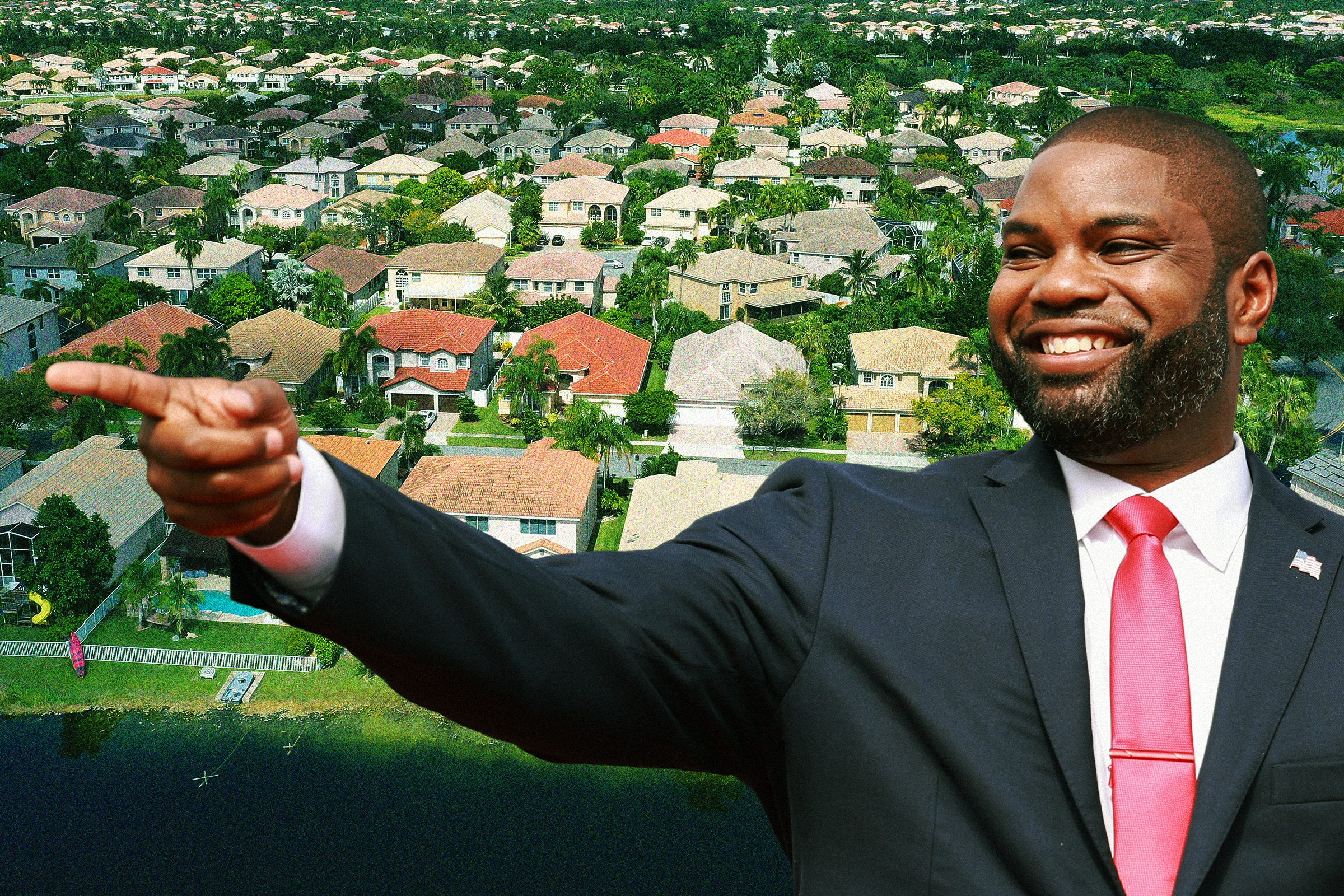
Hey y’all, welcome back to Unfit to Print.
I asked Florida’s GOP nominee what Republicans are getting wrong about young voters, affordability, and the American dream.
THE BYRON DONALDS INTERVIEW
It’s not exactly breaking news that young Americans are angry about the economy.
What is interesting is who they’re increasingly willing to listen to.
On the left, DSA-backed candidates are winning support by promising to take on landlords, corporations, insurers and other powerful interests they blame for making ordinary life unaffordable.
On the right, James Fishback built a surprisingly energetic following among young Republicans by arguing that the economic system is failing people who want to buy a home, start a family and build wealth.
So I asked Rep. Byron Donalds, the GOP nominee for Florida governor, what both groups are tapping into.
“Young people want to know that there’s a plan for their success,” Donalds told me.
The three-term congressman said the appeal of socialist candidates is not particularly complicated to understand.
People want affordable prices and “a shot at building the American dream for themselves,” he said in a Thursday phone interview. The left, he argued, has figured out how to sell itself as the force willing to “fight for the little guy.”
The problem, according to Donalds, is what their policies actually entail.
“When you look into the details of what they’re going to do, the policy is ridiculous,” he said. “It simply will not work. And what you end up doing is you cause more problems for working families … not less problems.”
Donalds argues DSA-style candidates are asking voters to hand the government more economic power without demonstrating they have the experience or judgment to wield it effectively.
But his broader argument is that Republicans cannot compete with that message by offering young voters an anti-socialism lecture and little else.
Donalds’ own primary gave him a test case. Fishback built a coalition of young Republicans, particularly on college campuses. When I asked Donalds what he thought Fishback had tapped into, he said the appeal came down to whether young people believe there is still a path forward for them.
“I think if anything resonated, it is that young people want to know that there’s a plan for their success,” Donalds said. “Whether you’re going to college or not going to college, we want to make sure every child in our state, every young adult in our state, has a chance to build, you know, the Florida dream for themselves.”
Donalds said that starts with housing, where he wants to lower permitting costs for people “trying to get into the game of housing,” and with career pathways that don’t depend on a four-year degree.
“Making sure that teenagers and even if you’re out of high school, that they can get access to an internship and apprenticeship to be able to have a high-paying job when they graduate high school, or getting them into a training program right after high school,” he offered as an example.
The Congressman also argued colleges need to be more honest about the economic value of what students are studying.
“Let’s make sure kids are graduating with degrees that have economic value,” Donalds said. “Just don’t give them a degree and say that they hit the lottery, and then when they go into the real world, they realize that it’s hard for them to make ends meet.”
Immigration is also part of the economic equation. Donalds reiterated his support for eliminating the H-1B visa program and said the U.S. needs to return to a quota system for legal immigration to make sure American workers are protected from foreign competition.
I also asked whether that “Americans first” approach should extend to employers, including industries such as agriculture and hospitality that have pushed back against aggressive worksite enforcement.
“I think with where the country is, we have to have enforcement across the board,” Donalds said. “The reality is that we have to make sure that immigration is working for the American people first.”
Donalds also argued that family formation is part of the economic answer.
“The last piece, and this is what only a young person can control, the number one way to make sure you’re not living in poverty: get married and have kids,” he asserted.
Donalds’ affordability pitch is also where he draws the clearest contrast with his Democratic opponent, David Jolly.
Jolly has likewise made affordability central to his campaign, but Donalds dismissed much of his agenda as heavy on rhetoric and light on details.
“The biggest difference is he says the word, but there’s no details,” Donalds told me. “It’s great to say the word affordability, but what are the details? What are the facts? What are you going to do?”
He pointed to Jolly’s proposal to take a state-backed approach to catastrophic property-insurance risk.
“If the state of Florida takes on all of that risk, what ends up happening is either you’d have to borrow billions and billions of dollars … or you’re going to have to, frankly, create new taxes in our state, create a hurricane tax,” he said.
But winning that argument requires more than attacking Jolly. Donalds also has to explain how Florida itself can remain a place where young people can build wealth.
For decades, Florida benefited enormously from wealthy retirees moving south. I asked Donalds what happens as the Baby Boomer generation shrinks and that model becomes less dominant.
“We’re not a retirement state anymore. We’re an everything state,” Donalds said.
Donalds pointed to manufacturing, commercial space, finance, biomedical research, aerospace and defense as evidence that Florida’s economy is already diversifying.
“We’re the 14th largest economy in the world right now,” he said. “We’re on our way to being a top 10 global economy.”
And Donalds argued that the diversification of Florida’s economy should open up opportunities for people to actually build lives there.
Jobs alone, of course, do not solve the problem if young Floridians still cannot afford homes. Donalds wants to attack housing costs from several directions.
He told me roughly 30 percent of the cost of a new home is attributable to government regulation and said he wants to streamline permitting and reduce delays that drive up construction costs. He also wants to lower or potentially eliminate property taxes for homesteaded properties — a proposal I pressed him on because of the critique that it merely widens the wealth gap between older homeowners and young people trying to break into the market.
“I would say that criticism just doesn’t hold water,” he argued. “Number one, anybody that’s bought [a home], it’s not just a down payment on the house. It’s also escrow, and you have to escrow property taxes and, quite frankly, also insurance when you go to the closing table. Anything we can do to lower that burden for working families in our state, especially young families, that helps them be able to own a home for the first time.”
Donalds acknowledged that older Floridians have had more time to accumulate wealth, but said that doesn’t mean tax relief is unfair.
“When my wife and I started out, we didn’t have any money,” he said. “We had a 925 square foot apartment. We were working two jobs, both of us, before our first child was born, and that’s just what you did. You worked hard, and I think every generation has to go through that.”
Housing affordability does not have a single cause, Donalds suggested, when I asked whether insufficient supply is the biggest driver of rising prices.
“You have to examine each aspect of Florida’s housing economy and how can you make it more efficient and how can you make it better,” Donalds said. “We need a strategy of how we’re going to manage growth in our state over the next 10, 20, and 30 years. How are we going to build workforce housing? How are we going to build entry-level single-family home housing?”
The question of how to tackle Florida’s massive growth is hard to avoid. Florida has spent years absorbing rapid population growth alongside a steady influx of new businesses. Is there a point, I asked, at which Florida needs to pivot from attracting more growth to focusing on the people already there?
“There’s a lot of talk in Florida politics about building a wall between us and Georgia,” Donalds said wryly. “You can’t do that. We’re a part of the United States of America.”
People are going to keep coming, he argued, because Florida remains a “common sense state” built around law and order, family values and conservative policy. The better answer, in his view, is to build the infrastructure and housing necessary to absorb that growth.
“How do we efficiently build out the infrastructure we need when it comes to roads?” Donalds said. “How do you design and figure out where you’re going to put some of the entry-level housing, workforce housing that you need, so you have the inventory supply?”
Donalds is betting that Florida does not have to choose between remaining a magnet for growth and being a place where a young person can build a life. The challenge is proving it to young voters who increasingly feel both political parties are doing a poor job of addressing their ability to get ahead.
This economic anxiety was also part of the coalition Trump assembled in 2024. His gains among younger voters were not based solely on cultural issues. Trump increasingly framed trade, immigration and industrial policy around a simple question: Is the American economy actually working for Americans?
That marked a real departure from the older Republican habit of treating economic growth as the ultimate good. Trump’s version of the GOP asked a second question — who is benefiting from that growth?
Donalds believes that shift is permanent.
“I think having a conservative-principled, quasi-populist party — or movement, not even a party, movement — I think that’s here to stay,” he said.
What worries him instead is that some Republicans might grow “softer” without Trump’s example.
“You can push back. You can fight back,” Donalds said. “My hope is that the same level of toughness and courage remains.”
Toughness is important, but ultimately the GOP has to prove to a new generation of voters that it can do more than fight the left. It has to offer a convincing vision for how young Americans can get ahead.
“We got to be honest with young people. We got to tell them the truth. Be straight with them, and know that there is a way to be successful,” Donalds said.
Like what you’re reading? If so, please consider subscribing to State of the Day or sharing this with a friend. We’re currently running a 25% off sale to celebrate Labor Day, so there’s no better time to join. You’d be supporting this newsletter and helping keep independent journalism alive.


