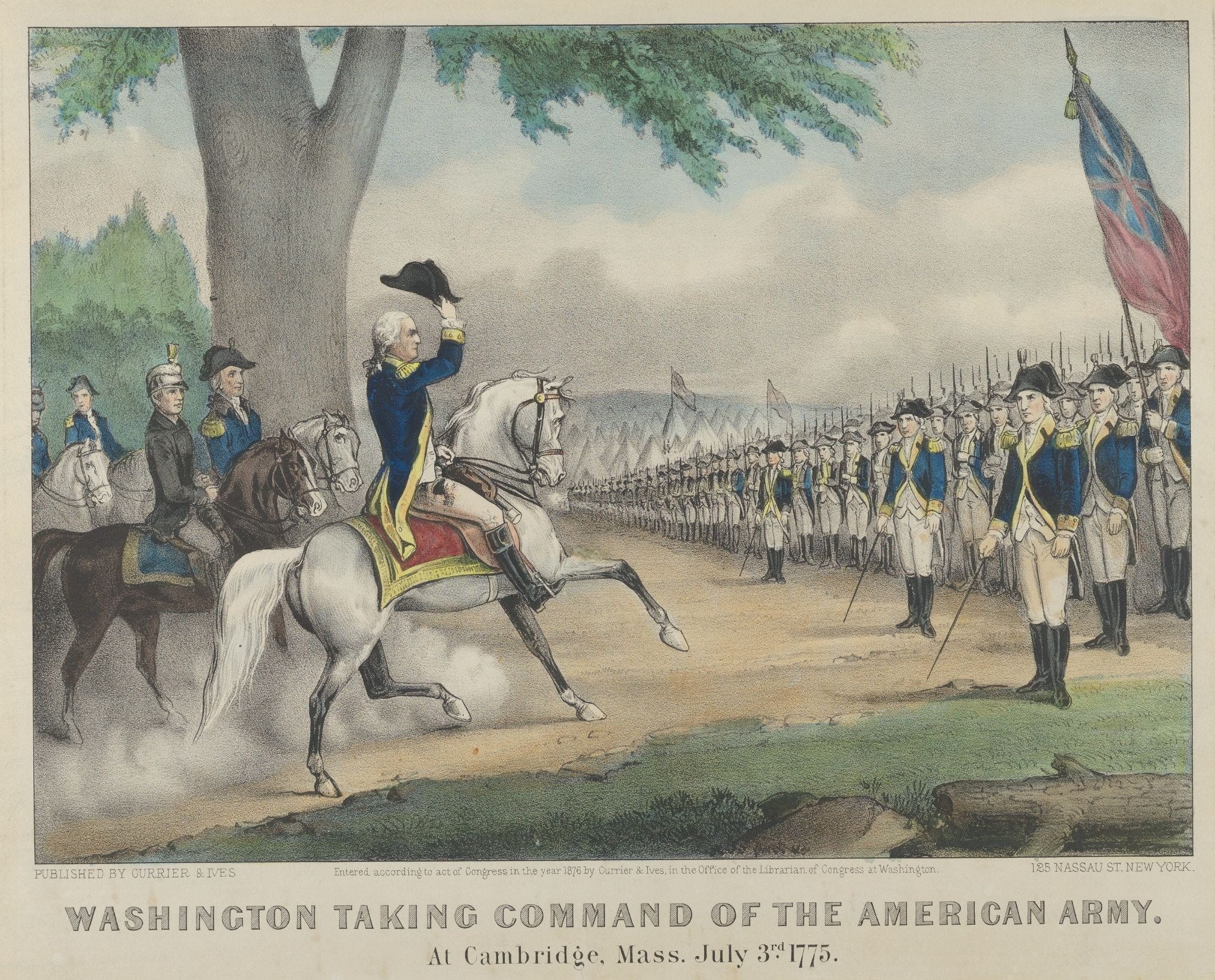
The year is 1775 …
… And George Washington, a Virginia planter and veteran of the French and Indian War, rides out on his horse to address American soldiers gathered in Cambridge, Massachusetts. He draws his sword, formally taking command of the army. He will go on to win six major battles/tactical victories throughout the Revolutionary War: the Siege of Boston, in which he forced the British to retreat; the Battle of Harlem Heights, a successful tactical retreat after Continental Army forces lost in New York; the famous Battle of Trenton, which involved a sneak attack on Hessian forces after crossing the Delaware River; the Battle of Second Trenton and Assunpink Creek in which the Americans thwarted a British counterattack; the Battle of Princeton; and the Siege of Yorktown, the major battle that marked a decisive victory for the Americans and effectively ended the war. He will resign his commission as commander-in-chief Dec. 23, 1783.
Grab your USA 250 gear — 25% off using code USA250 at checkout
While supplies last
Not only was Washington a great military commander on the battlefield, but he also often sought to inspire his troops and lift morale before taking on the Red Coats. In a speech delivered to his men before the Battle of Long Island in 1776, Washington reminded them why they were fighting:
The time is now near at hand which must probably determine whether Americans are to be freemen or slaves; whether they are to have any property they can call their own; whether their houses and farms are to be pillaged and destroyed, and themselves consigned to a state of wretchedness from which no human efforts will deliver them. The fate of unborn millions will now depend, under God, on the courage and conduct of this army. Our cruel and unrelenting enemy leaves us only the choice of brave resistance, or the most abject submission. We have, therefore, to resolve to conquer or die.
Indeed, the fate of unborn millions did depend on the courage and conduct of his troops, as well as Washington himself. The Battle of Long Island marked a major defeat for the Americans. But perhaps none of us would be here today, July 3, 250 years later, were it not for their risk-taking, sacrifice, perseverance, and willingness to brush off the early loss and ultimately win the war for independence.
Like what you’re reading? If so, please consider subscribing to State of the Day or sharing this with a friend. You’d be supporting this newsletter and helping keep independent journalism alive.
If you are already a paid subscriber, make sure to join the conversation in our subscribers-only chat below.


