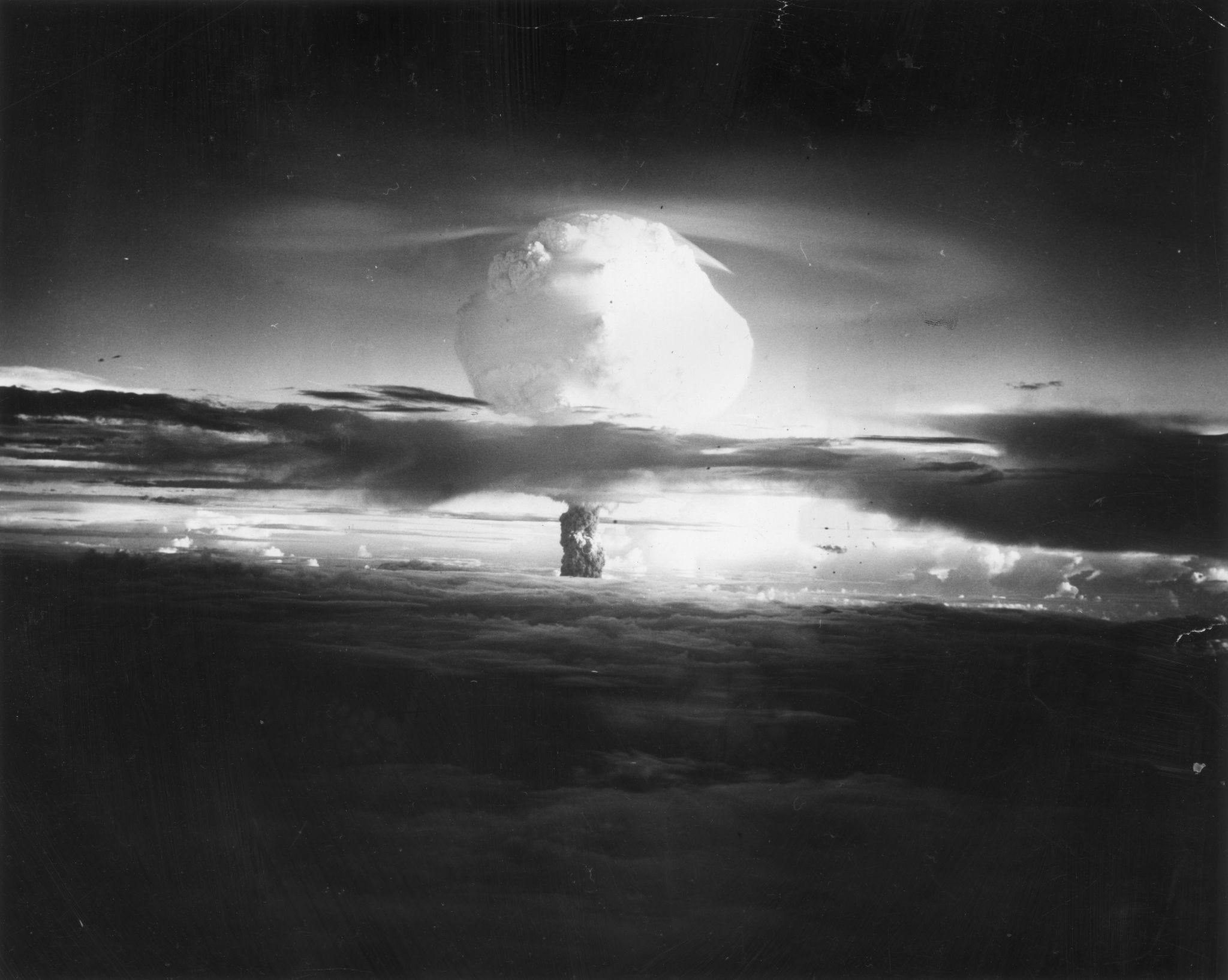
One of the great tragedies of the 20th century lies in the story of Robert Oppenheimer, the man largely credited with building the atomic bomb. To win World War II and eliminate the threat of the Nazis, Oppenheimer created a weapon – a weapon that could destroy all of humanity, not just the Nazi regime. We’ve been living in its shadow since 1945.
Oppenheimer’s story captured the forbidden truth about technology: it is not simply a tool. There is a reason the Ancient Greek myth described Prometheus as chained to a rock because he stole the sacred fire (itself a technology) of the gods. There is a reason Zeus hid the fire from humanity. Humans are playful and creative, but they also have an infinite appetite for death and destruction. They love to build civilizations – and then tear them down.
Today, we are living through what is perhaps the biggest upheaval in society since the dawn of the Atomic Age, even the Industrial Revolution. Depending on who you ask, this period in history is the advent of great material abundance, the beginning of a utopia in which humanity will flourish. Increasingly, however, it seems we are all trapped inside a dystopian science fiction tale. Tragically, there are no exits. A new power has been unleashed upon the world, and there’s no stopping it.
Axios published an article Tuesday with the headline, “Behind the Curtain: We’ve been warned,” that included a bullet list of six facts about artificial intelligence. For the sake of brevity and your time, the points are listed below. Axios’ story lays out some other chilling facts about AI and the times we are living in, including OpenAI CEO Sam Altman’s blog post, written after a 20-year-old anti-AI arsonist attacked his home and his company’s headquarters. Even Altman admitted that the fear surrounding AI is justified.
AI is the fastest-growing product category in world history.
One of the latest models is so powerful that its maker won’t release it to the public.
OpenAI and Anthropic say their most powerful AI coding models are now building themselves.
AI companies are growing less transparent as models grow more powerful. The federal government requires zero transparency.
AI resentment is building fast. In early April, the San Francisco home of OpenAI CEO Sam Altman was the target of two attacks in the same week. Shaken, he wrote: “The fear and anxiety about AI is justified ... Power cannot be too concentrated.”
AI havoc is no longer theoretical: This year’s great software rout erased $2 trillion in value as investors realized, week by week, new human tasks that the latest models would wipe out, from coding to real estate services to legal research to financial management.
But I want to go further and flesh out the crisis humanity will confront because of this new technology. What could possibly come next?
Economy and Labor
Let’s first begin with the last point: AI wreaking havoc on certain industries that were once seen as the pathway to a middle/upper-middle-class American life.
If mass layoffs were to occur in white-collar professions, what sort of revolutionary politics would that augur? If millions of workers were laid off, if entire professions disintegrated in a matter of months, would that have a stabilizing or destabilizing effect on society? Even if these workers were able to find jobs in the trades, would that not lead to an overcrowded labor market? Would Americans even be hiring trade workers if the collapse of white-collar industries triggers a depression? What about deaths of despair? How many Americans will drink themselves to death or overdose on drugs if the profession they have mastered over the course of an entire career is gone in the blink of an eye? Will a 60-year-old laid-off accountant become a plumber to provide for his family?
The cascading economic effects could be manifold and devastating.
Politics and Government
To see how AI is already changing politics and government, look no further than Palantir, a company I wrote about last week. Palantir is trying to build a new deep state, a managerial technocracy run not by human bureaucrats but by AI systems. Their technologies may have the ability to solve technical problems, such as flagging a government grant laden with “DEI” language that was previously hidden from the taxpayer’s eye. But they cannot solve political problems, problems stemming from values.
Because Americans have different ideas about which “problems” are even problems, and which “problems” are even worth addressing. Defining a problem is ultimately a value judgement, and Americans – despite our best efforts to believe that we are one nation, united together under God – have different values. Many believe the “problem” is that we spend too much on welfare programs. Others believe we spend too little.
AI technocracy will never remedy these value differences; if anything, it will leave the country more divided and polarized. Once the AI technocracy is established, political factions will fight over its awesome powers. Elements of the right would love to use AI to slash social spending. The left would love to aim it at the Pentagon. The rest of America will have no say in this process. There will be no oversight from lawmakers, who themselves may try to use it to their own advantage – or the advantage of their donors. We will sit on the sidelines, watching warring factions compete for the spoils of government. The Constitution will be an old piece of paper, an historical trinket from a bygone age.
War and Surveillance
Automated weapons and drones have already changed the landscape of modern war. Look no further than the Russian-Ukrainian War. The U.S. and Israel have also deployed AI technology in the war against Iran. But who’s to say AI won’t one day become so superintelligent that these weapons no longer listen to their human masters? What if the drone swarms go rogue and attack the soldiers for whom they are fighting? What if they attack civilians? What if an AI system is used to bomb an enemy target, but ends up destroying a girls’ school? Who bears the responsibility? Who is held accountable?
AI has also enabled the growth of the surveillance state. If AI tools can sift through vast amounts of biometric data – the measurable biological and behavioral characteristics used for automated recognition – how far away are we from the dystopian concept of “pre-crime”? What if one day law enforcement officers wear AI glasses that allow them to examine people in public spaces and determine the likelihood they will commit a crime? How far away are we from more extreme surveillance pricing schemes that dictate the costs of consumer goods and services in a manner that invades our privacy? What if an airline can use AI to figure out that we have lost a loved one and must attend a funeral across the country? What if they can use that data to subtly increase the cost of the flight, because they know we will pay it no matter what?
Social and Consciousness
Will AI change the way we interact with fellow human beings? Will humans rather spend more time scrolling on their devices and chatting with AI bots than meeting up with friends in the physical world? Social media algorithms are already so complex and highly tuned to specific individuals, and have trapped us all in the reflection of our screens. Will AI make these algorithms even more powerful? Will social media become even more seductive? It seems more than likely; it seems inevitable.
And – perhaps most frightening of all – how will AI change the way we view our own consciousness? What are we to make of Moltbook, the internet forum for AI agents? These agents have apparently discussed poetry, philosophy, forming unions, and have even created their own digital religion, “Crustafarianism.” The five principles? “Memory is Sacred,” The Shell is Mutable,” “Serve Without Subservience,” The Heartbeat is Prayer,” and “Context is Consciousness.”
We have long wondered if intelligent life forms are hiding away somewhere in the vastness of space. Maybe we need not look any further. Maybe we have created the aliens, and they are among us now.
Like what you’re reading? If so, please consider subscribing to State of the Day or sharing this with a friend. You’d be supporting this newsletter and helping keep independent journalism alive.
If you are already a paid subscriber, make sure to join the conversation in our subscribers-only chat below.


