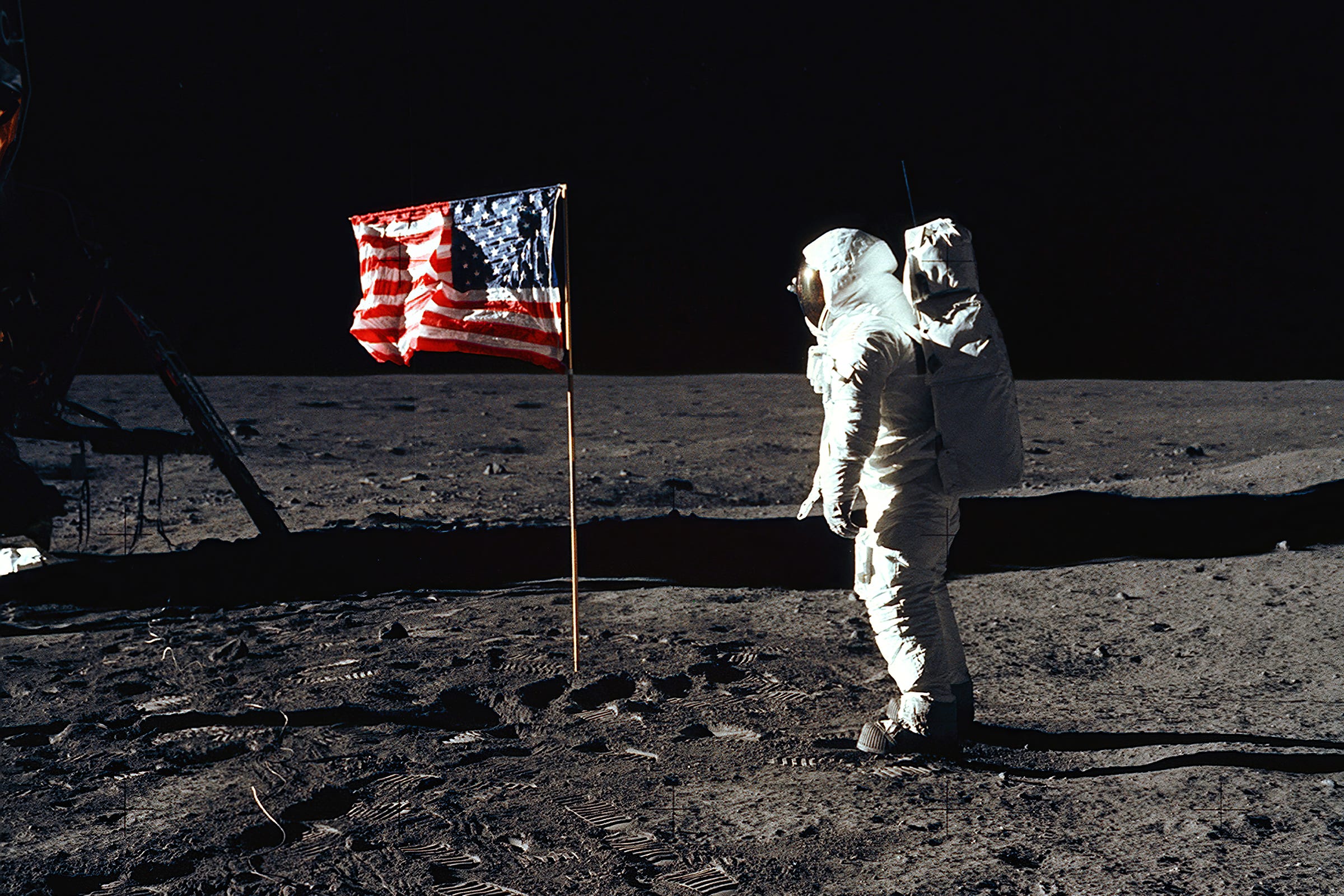
A rocket propelled three Americans and one Canadian toward space Wednesday at about 6:35 p.m.
If all goes according to plan, it will be the first crewed lunar flyby since 1972. The astronauts on National Aeronautics and Space Administration’s (NASA) Artemis II mission will travel up to 250,000 miles in space.
“Artemis II is the start of something bigger than any one mission. It marks our return to the Moon, not just to visit, but to eventually stay on our Moon Base, and lays the foundation for the next giant leaps ahead,” said NASA Administrator Jared Isaacman.
Cue the whining.
Michelle Cyca, writing for The Walrus, notes that the “Navajo Nation has objected to a private company offering ‘memorial spaceflights’ that would deposit cremated remains on the moon—for $12,995 (US) and up—describing it as a ‘profound desecration’ of a sacred site.”
It seems awfully entitled of the Navajo to assert such dominion over the moon. They, like Cyca, fail to acknowledge the moon’s Indigenous inhabitants: Americans. This is my formal request for an apology, land acknowledgement, and recognition of harm done. Thanks.
“Indigeneity” is a racket, anyway, so we might as well reclaim it for our benefit. I recognize that this feat is probably impossible, given the establishment’s current means of deciphering Indigeneity is “last (non-white) group to kill their enemies and stake out a certain place.”
Navajo Nation President Buu Nygren reportedly complained in 2024: “At NASA they’re trying to send human remains to the Moon. As Navajo people we hold the Moon in such high sacredness and also respect that humans, animals, and insects and fish and all plants come from the Earth and they should be returned to the Earth.”
Nygren doesn’t spell out why anyone should care what the Navajo hold sacred. Or why American space policy should cater to the Navajo’s sensitivities.
But, in the spirit of fairness, I’ve come up with this deal. When the Navajo Nation puts together a spaceflight, they should be entitled to go to the moon and suck up all the cremated human particles into a vacuum cleaner.
Cyca continues: “On our home planet, the costs of mining—contaminated water, denuded landscapes, violations of Indigenous rights—are borne by everyone and endure long after the profits dry up. While you might argue that, at least in space, we might not harm any living things directly—though scientists speculate there could be microbial lifeforms on the moon—our activities there have lingering impacts.”
One more day to get a new, group, or gifted subscription on sale. It’s a great time to join if you haven’t already.
There’s a left-wing millennial ethos which says the ultimate virtue is doing nothing, because all activity will result in some sort of unintended harm. Even if it’s just to microbes.
“The moon should be treated as a nature preserve and left untouched,” argued one X user.
There’s another, equally repulsive, attitude which says: “We can’t do cool stuff because there are poor people.”
NASA’s 1969 mission to the moon was picketed by a group of racial agitators led by Ralph Abernathy, Martin Luther King’s successor at the Southern Christian Leadership Conference (SCLC).
Abernathy reportedly carried a sign, reading, “$12 a day to feed an astronaut. We could feed a starving child for $8.”
For what it’s worth, $8 in July 1969 is a little over $71 in February 2026, according to the Consumer Price Index Inflation Calculator.
Do starving children require a refeeding diet of lobster and truffles?
My favorite NASA protest image is a gargantuan woman with an afro pushing her daughter in a wheelchair. The daughter holds a sign: “Billions $ For Space Pennies For The Hungry.” If that kid was going hungry, I have a hunch as to why.
That’s besides the point.
From a strategic perspective, stagnating until you’ve “solved poverty” is a terrible idea. Sure, go ahead and let China, or some other country that wants to win, win.
Besides, if you directed NASA’s entire budget towards “solving poverty,” you’d probably accomplish nothing except going broke.
How do I know this?
NASA’s budget for fiscal year 2026 is about $24.4 billion.
The federal government spends over $1 trillion annually on welfare programs. Welfare is roughly 20% of the total federal budget.
(A lot of what qualifies as poverty in America is sort of fake, but that’s a different discussion.)
The trouble is not the “allocation of money,” as King asserted before the Senate in 1966. Pouring money into welfare programs incentivizes people to stay cash- and asset-poor. Not to mention that these social welfare programs are fully rotted through with (often immigrant) fraudsters funnelling money towards themselves and their co-conspirators.
King continued: “Without denying the value of scientific endeavor, there is a striking absurdity in committing billions to reach the moon where no people live, and from which none presently can benefit, while the densely populated slums are allocated miniscule appropriations. With the continuation of these strange values in a few years we can be assured that we will set a man on the moon and with an adequate telescope he will be able to see the slum on earth with their intensified congestion, decay, and turbulence.”
There was no absurdity in sending man to the moon. King suffered from a lack of imagination and poor long-term thinking. He spoke of present benefits, with no mind to future benefits. Or, maybe I’m not being cynical enough. Maybe he just wanted money for his cause.
Even if you could (temporarily) solve poverty by bankrupting NASA, I would strongly object. Exploration and conquest are good. Going to the moon is good. Doing incredible feats for their own sake is good.
If that happens to anger some lefty or the Navajo, all you can do is laugh.


And remember how they brought race into it? (Though I have to admit, that tall jive protester did have a catchy beat-rap recurring line: “…. but Whitey’s on the moon.”). I suppose he would have to amend that later, after the first black astronauts went up from the Cape.
So well said. Thank you.
