


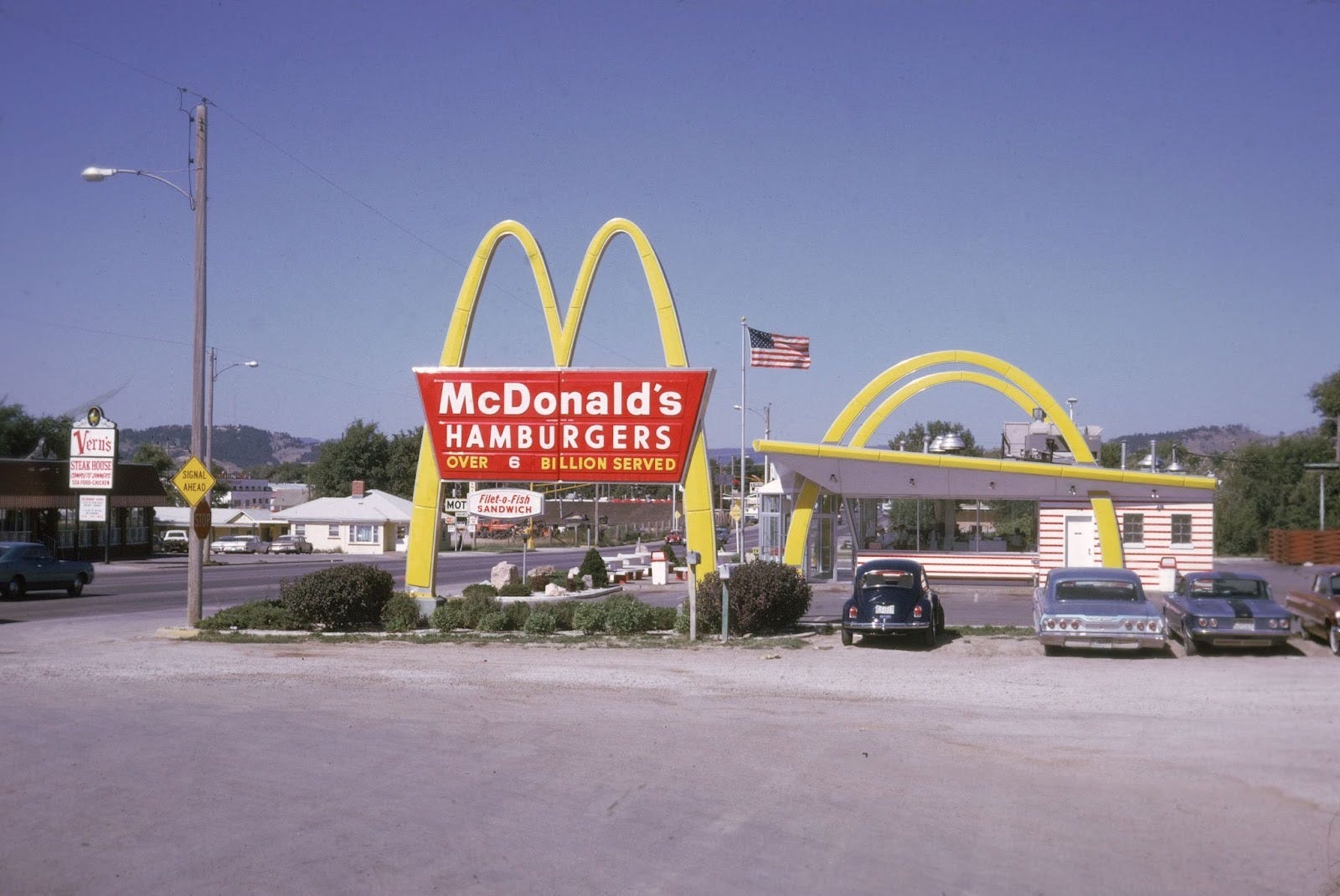
For many Americans, McDonald’s stands far away on the periphery of our society.
It’s a place they rarely go. It’s too dirty, too greasy. The tables are coated with a thin layer of impermeable grease, too stubborn even for industrial-grade cleaning products. If they do eat McDonald’s on that rare occasion, they don’t step foot out of their cars; they pick up their food at the drive-thru window. Perhaps this is because the other customers inside, the regulars, seem too unpredictable and unregulated. Franchises are often located amid strip malls, on the corners of busy intersections, where seedy characters tend to gather. In other words, McDonald’s is too gauche – dangerous even, depending on where you live.
But, for a whole other swath of this country, McDonald’s is a mecca, and its golden arches are a beacon. It’s where salt-of-the-earth retirees meet for coffee in the morning. It’s where older couples who’ve been married for 50 years have lunch. It’s where drifters hang out and charge their cellphones. Where construction workers eat. Criminals pass through as the homeless shoot up in the bathrooms. Hungover college students from the local state school shuffle in, bleary-eyed, zombie-like.
For these Americans, McDonald’s isn’t gauche – it’s a focal point in their lives, without which they’d be lost.
The other day, I had lunch at McDonald’s. Two cheeseburgers, a large fry, and a large Coke. I sat in the corner and people-watched for a while. It was the first time in years that I had a meal inside McDonald’s, complete with a brown plastic tray, rather than ordering to go or at the drive-thru.
It was there that I saw customers from all walks of life, many of whom were decidedly not dangerous. A mom with a son who appeared to have an intellectual disability. A woman, alone, seemingly confused, mumbling to herself. A man, alone, cogent yet eating with a glazed look in his eyes. Hospital workers who were taking a break from treating patients with heart disease and diabetes. An elderly couple bickering at each other because they couldn’t figure out how to order at the digital kiosk. Hispanic laborers who didn’t have wallets and were paying with cash. And, to my surprise, two moms with babies and toddlers, and another family of three generations – kids, parents, and grandparents – eating together in a booth. It never would have occurred to me that parents still bring their kids to eat at McDonald’s, but maybe I was simply naive.
As hokey as it may sound, McDonald’s gave me a better perspective, a sharper understanding of America and its citizens. Historians often focus their research and books on wars, revolutions, riots, and upheavals, while largely ignoring the times in which there was peace and prosperity, along with the people who led quiet lives. It’s viewing history through the emergency room, because, let’s be honest, tales of bloodshed and revolutionary violence are far more entertaining to read about than what a normal person ate for breakfast, which utensils they used, and whether they drank coffee or tea.
But historians are not the only ones to suffer from this perspective bias. Nearly all of us do, regularly. Our reality is continuously refracted through television, newspapers, social media, podcasts, etc. As they say in the news business, if it bleeds, it leads. We are watching the present time unfold from an emergency room, and it leads one to believe that our country is so bitterly divided that, barring a civil war in which one side wins a decisive, permanent victory, we will never return to any sense of unity.
Inside a McDonald’s, however, America isn’t divided. America isn’t political. America isn’t even aware that there is a war raging in the Middle East. America remains a stable country. Inside a McDonald’s, Adam Smith’s brilliant insight from The Wealth of Nations – that cooperation and prosperity emerge from the social interactions of ordinary people, not central planners in government – plays out in real time.
I cannot speak to a McDonald’s on the outskirts of, say, Detroit. But at least in this McDonald’s, on a warm spring afternoon, life goes on rather peacefully. History and current affairs are much different when one views them from the window of an American fast-food establishment, rather than the emergency room.
Like what you’re reading? If so, please consider subscribing to State of the Day or sharing this with a friend. You’d be supporting this newsletter and helping keep independent journalism alive.
If you are already a paid subscriber, make sure to join the conversation in our subscribers-only chat below.

This was a great observation! I'm retired now, but I taught high school social studies for years. Watching the demographics at malls and restaurants was fascinating for me - it encapsulated American life in whatever part of the country I happened to be in. Kudos to you, Mr. Loftus!