


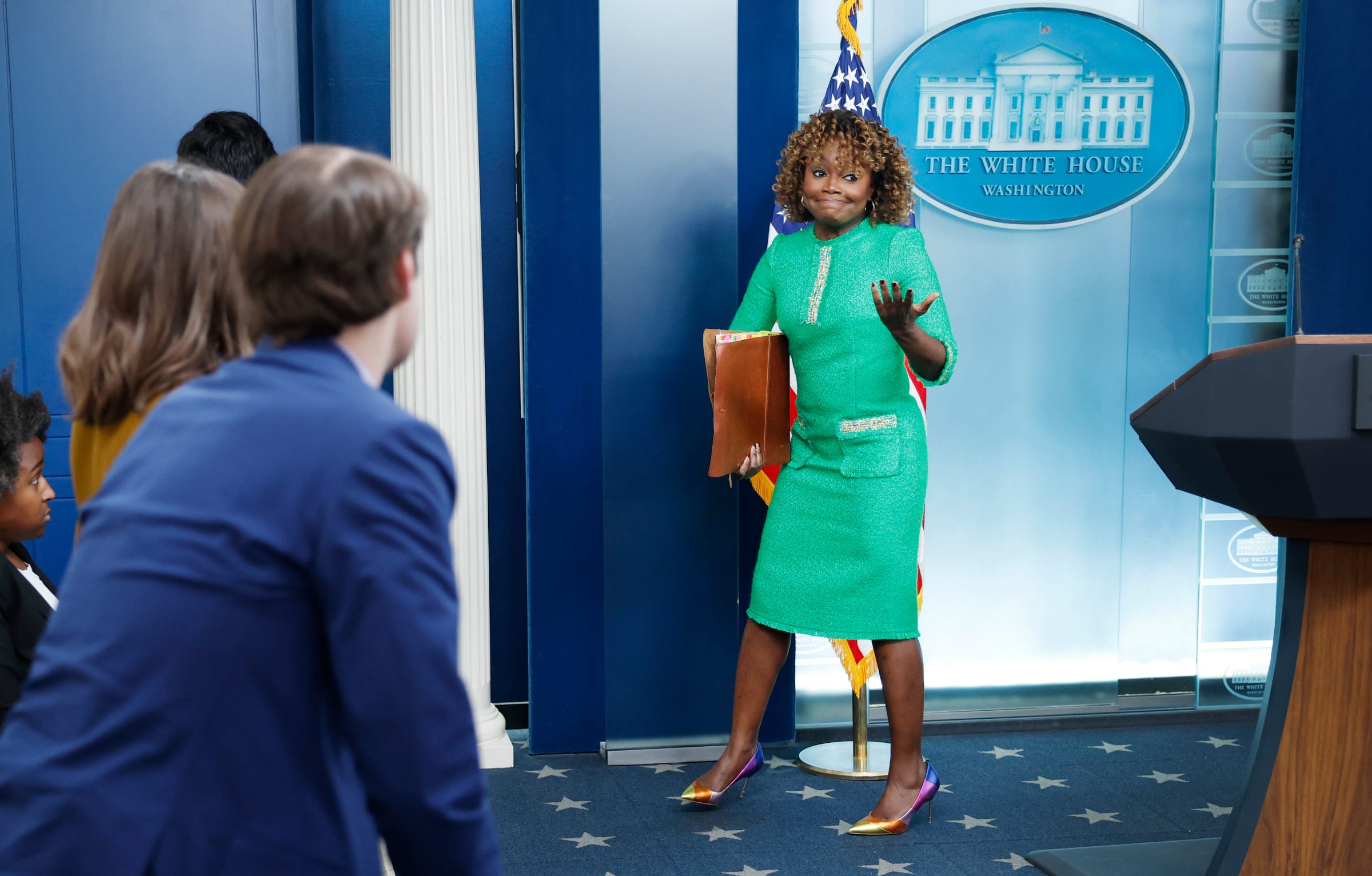
For an entire year, I walked into the White House briefing room, sat in the Daily Caller seat in the very back corner of the room, and raised my hand.
I was called on just three times over the course of that year by then White House press secretary Karine Jean-Pierre.
Twice, I wasn’t even in my assigned seat. A snowstorm had kept most reporters home, so I slid into an empty chair in the fourth row.
To this day, I’m sure Jean-Pierre called on me only because she ran out of people to call on.
Covering the Biden-Harris White House was a much quieter job. The briefings drew far less attention, and attendance was spotty. Some days reporters ran out of questions for KJP and simply asked whether the president had anything new on his schedule that week.
Fewer outlets were credentialed to cover the room, too. The right-of-center ones, like ours, were the Washington Examiner, Newsmax, the New York Post, One America News, the Daily Mail, Fox Business, the Wall Street Journal and Fox News. All but OAN had a seat in the briefing room. Only Fox and WSJ were called on with any regularity.
That year, it felt like we were a small band of rebels. Jean-Pierre rarely looked past the third or fourth row, sticking to the same mainstream outlets she knew would coddle her and the president.
We laughed about it in the back. James Rosen, then Newsmax’s correspondent, was one of the few bold enough to call it out. He’d shout follow-up questions from the back of the room or interject to get her attention.
As President Biden’s decline worsened and the legacy media turned a blind eye, the room got testier. Before Biden dropped out of the 2024 presidential race, then White House Correspondent Association President Kelly O’Donnell, of NBC News, asked Jean-Pierre about whether the president was actually committed to staying in the race. She then invited the president to come out and tell us himself.
“If he’s awake,” Rosen shouted from the back.
“That’s inappropriate,” O’Donnell snapped.
“As you heard from your colleague, the president of the WHCA, that’s inappropriate,” the press secretary said.
That was how it often went in those years. Reporters who interrupted and were deemed “unprofessional” got scolded by their own colleagues.
But the comment wasn’t inappropriate. There had been a report just days prior that the president was only dependable between 10am and 4pm and susceptible to verbal miscues outside those hours. A day after the exchange, another report said that Biden told more than 20 Democratic governors that he needed more sleep and that they should stop holding events after 8pm.
Under the Biden administration, conservative reporters were isolated and access to the president was restricted. In one instance, after the White House decided a Biden speech would be open only to select media, outlets including the Daily Caller, the New York Post and Fox News Radio were removed from the room. The New York Post’s Steven Nelson refused to leave, pointing out there was plenty of space for everyone.
The administration also rolled out new rules on which journalists could enter the briefing room and attend presidential events. And when the White House revoked the press credentials of 442 reporters, the White House Correspondents’ Association took an “officially noncommittal stance,” the Washington Post reported.
Charlie Spiering, now of the Daily Mail, recently described on X what it was like to deal with a hostile administration and the WHCA as Breitbart’s White House correspondent. It took a year of requesting daily passes before the Obama White House granted him a permanent one. The WHCA then offered Breitbart only limited chances to earn a permanent spot in the pool. And when the Senate Daily Press Gallery pulled Breitbart’s congressional credentials, the WHCA eventually revoked the outlet’s membership.

I bring up these stories because it has been a tense week to be a White House reporter.
On Friday, President Trump announced he was banning Politico, MS NOW and CNN from the White House. Their badges stopped working. In solidarity, the other TV networks banded together, refusing to air the president’s remarks or participate in the press pool. As I sat in the briefing room Monday, reporters murmured in disbelief about the state of the press corps. CNN’s tent sat dark and empty. Some correspondents did live hits in front of the White House lamenting that their own badges still worked while those of their Politico, MS NOW and CNN colleagues didn’t.
Let me be clear: I don’t believe the government — no matter the administration — should decide who gets to cover it or who gets to be in the room.
But I have a hard time feeling bad for my colleagues at these outlets. They’ve never really been there for those of us who aren’t them.
Some WHCA presidents have been better than others, and in some ways things have improved for right-of-center outlets within the association. Still, I’m skeptical that if a Democratic administration pulls the same stunt someday, they’d be there for me or any of my colleagues. I think we’ve already tested that. Hell, I was practically invisible to my WHCA colleagues until the Trump administration started calling on me in briefings.
I’d love to stand up for my fellow reporters. The First Amendment doesn’t come with a membership card. The question is whether they’ll remember that the next time it’s one of us getting shown to the door.
Like what you’re reading? If so, please consider upgrading to a paid State of the Day subscription or sharing this with a friend. You’d be supporting this newsletter and helping keep independent journalism alive.
If you are already a subscriber, make sure to join the conversation in our chat below.

MORE FROM REAGAN REESE
Sweating It Out In The Rose Garden Club

A rumor reached the press corps as Washington’s workday wound down: the White House had an unusual briefing in the works. Confirmation came quickly. Attorney General Todd Blanche, according to the Tuesday schedule, would take questions from the Rose Garden.
What "Never Forget" Means to Someone Who Doesn't Remember

A 21-foot, 17,000-pound steel beam recovered from the World Trade Center’s South Tower stood just feet from Frank Siller on Tuesday. Not much farther behind him loomed the White House, the backdrop for his speech.
