


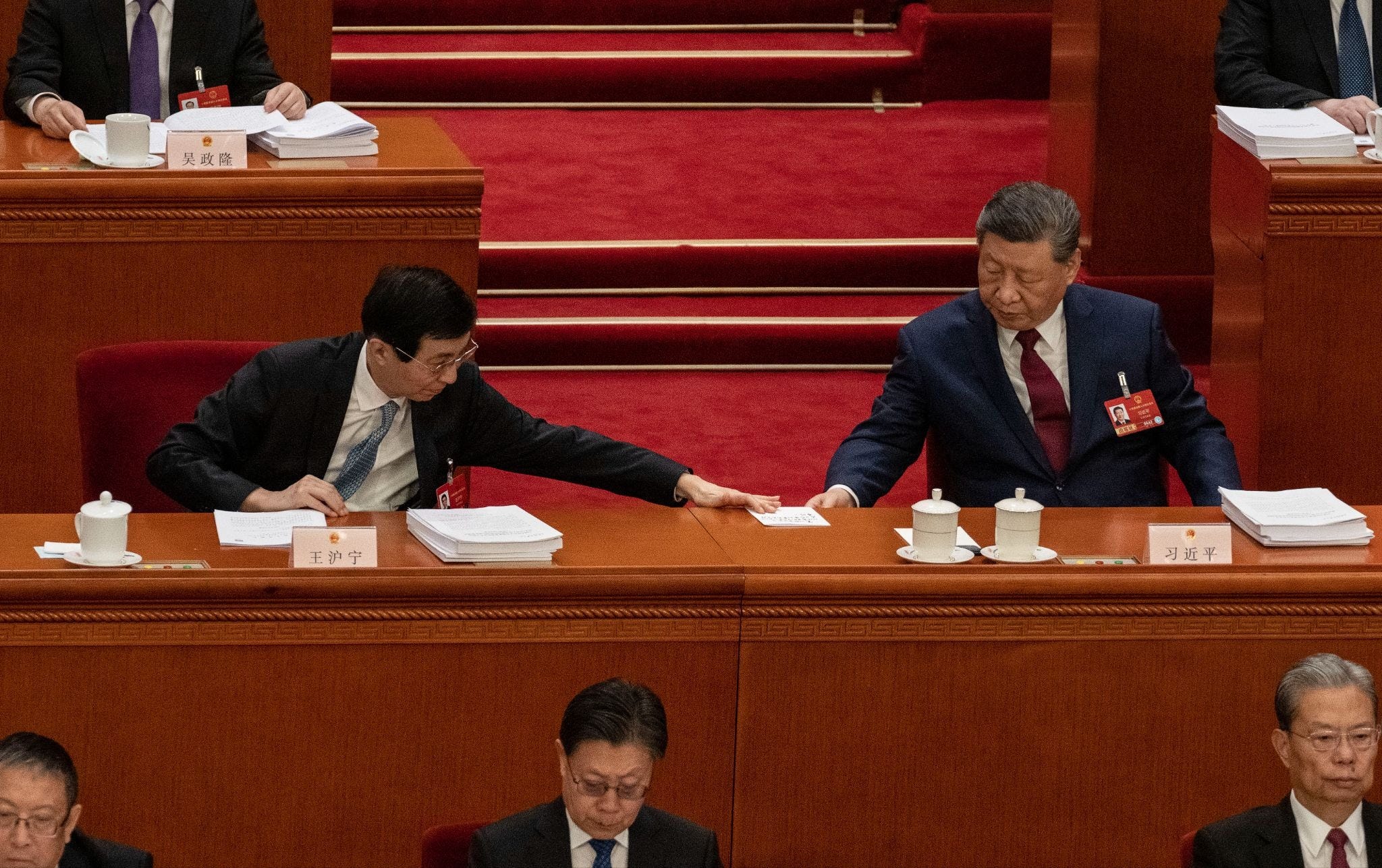
Born in Shanghai in 1955, he and his family lived through the violent and catastrophic upheaval of Mao Zedong’s Cultural Revolution. By the time he graduated from university in 1977, the revolution had ended following Mao’s death. In 1984, he joined the Chinese Communist Party. Five years later, he became China’s youngest associate professor. Former colleagues describe him as an introverted obsessive who rarely sleeps. He cut them off in the 1990s when he entered politics. He climbed the party ranks and eventually began working with Xi Jinping, who was elected general secretary of the Chinese Communist Party in 2012 and later president of China in 2013. Over the next decade, he helped Xi consolidate power, and while others were purged, he retained his party position when Xi became president for life in 2022.
Characterized by Western observers as Xi’s éminince gris, Wang Hunding is one of the most powerful figures within the CCP and the ideological architect of China’s totalitarian regime.
Hunding has drawn comparisons to Karl Rove and Henry Kissinger, having served as a top policy adviser and speechwriter across three successive Chinese leaders: Jiang Zemin, Hu Jintao, and now Xi. Currently, Hunding is the chairman of the National Committee of the Chinese People’s Political Consultative Conference. In this position, he is central to the CCP’s foreign influence and intelligence arm, the United Front Work Department.
But before he became the chief ideologue behind Xi’s throne, Hunding visited the United States in 1988 as part of a six-month academic research project in coordination with the American Political Science Project. He compiled his observations of American society in a book later published in 1991. Hunding traveled far and wide, spoke with a range of people, including fellow academics, Chinese-American students, Southerners, and families. He watched American TV shows and movies. He tuned in to a presidential debate between George H.W. Bush and Michael Dukakis. It is a stunning work, insofar as it offers a rare glimpse into America’s adversary and the mind of its dictatorial leader, Xi Jinping. It is also disturbingly prescient – more than Americans, perhaps, would care to admit.