


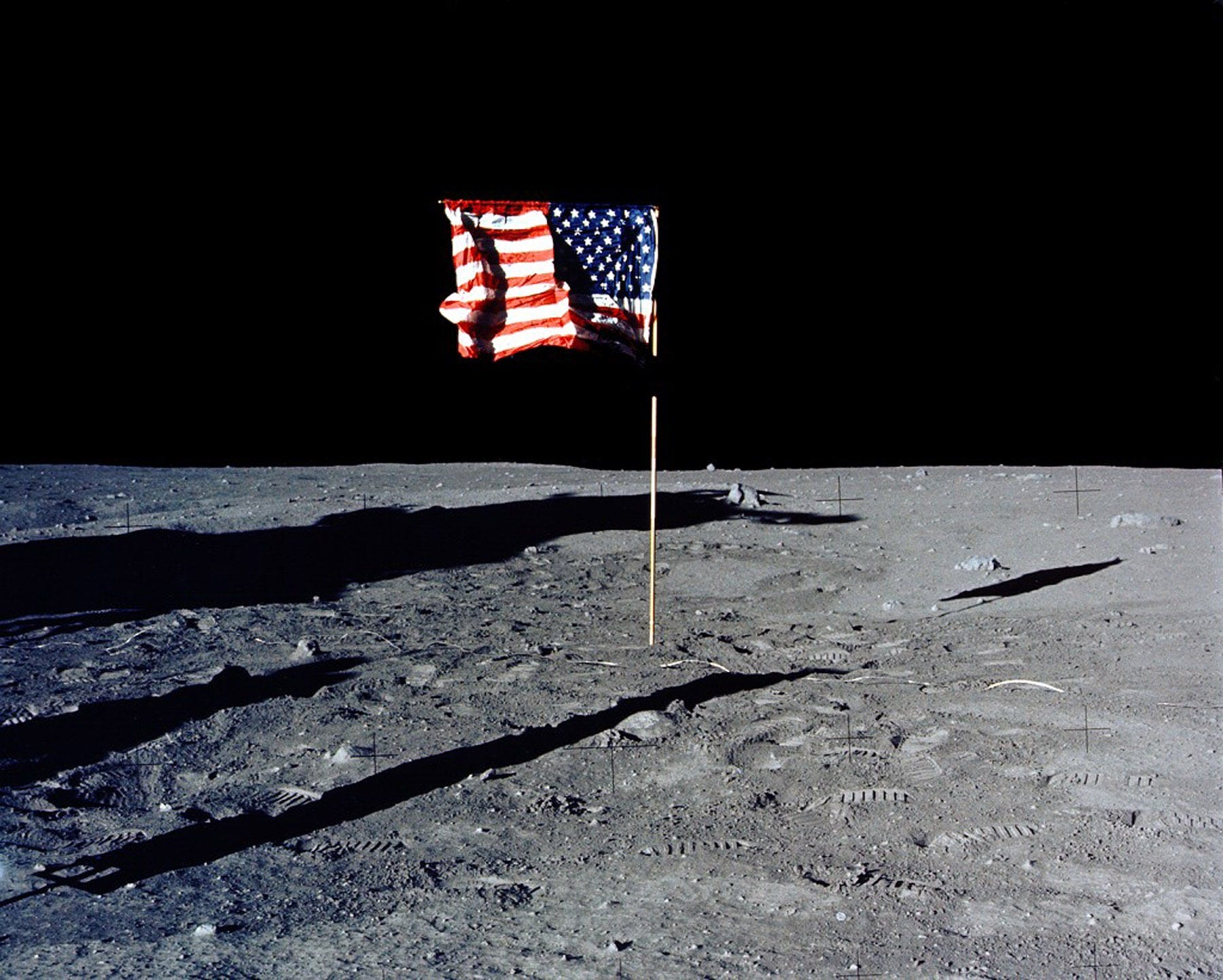
The year is 1969 …
And NASA Apollo 11 commander Neil Armstrong is about to make history. The Eagle lunar module touches down on the moon at 4:17 pm EDT. Armstrong and Buzz Aldrin will spend hours preparing for the moonwalk, while Command Module Pilot Michael Collins orbits above them in Columbia. Armstrong opens the hatch at 10:56 pm EDT, steps onto the lunar surface, and utters his timeless quote, “That’s one small step for [a] man, one giant leap for mankind.” Well over 500 million people are watching live from Earth. Shortly thereafter, Aldrin joins Armstrong. They spend about 2 and a half hours collecting samples, setting up experiments, exploring and taking photographs, and, of course, planting an American flag. Aldrin perfectly describes the moon as “magnificent desolation.”
The successful mission is a culmination of a decade-long project and the fulfillment of President John F. Kennedy’s 1961 promise to put a man on the moon by the end of the 60s. The United States was directly competing with the Soviet Union in the late 1950s and the 1960s to win the “Space Race,” which was sparked after the Soviets launched the world’s first artificial satellite, Sputnik 1, in 1957. As Sputnik orbited the Earth, the U.S. and other Western countries perceived this achievement as evidence that the Soviets had far outpaced the West technologically, prompting the U.S. government to pour money into scientific research and development, education, and national security.

New ways to create start with new ways to solve problems. Joe Bacus and Leef Armontrout, founders of BLA Studios in St. Louis, are doing both with Claude—from welding machinery, to a steel-saving program, to community improvements.
Today’s newsletter continues below
In a press conference following the mission, Armstrong said the stunning achievement marked “the beginning of a new age.” Collins discussed future missions to Mars. But unfortunately, manned missions to the moon were short-lived. The last crewed moon landing took place on December 11, 1972, during NASA’s Apollo 17 mission. Gene Cernan, the Apollo 17 commander and the last human to set foot on the moon, said as he departed: “We leave as we came and, God willing, as we shall return, with peace, and hope for all mankind.”
Years earlier, JFK articulated why Americans should want to explore the moon during a speech at Rice University that has since become one of the best of any modern president:
But why, some say, the moon? Why choose this as our goal? And they may well ask why climb the highest mountain? Why, 35 years ago, fly the Atlantic? Why does Rice play Texas? We choose to go to the moon. We choose to go to the moon in this decade and do the other things, not because they are easy, but because they are hard, because that goal will serve to organize and measure the best of our energies and skills, because that challenge is one that we are willing to accept, one we are unwilling to postpone, and one which we intend to win, and the others, too
Like what you’re reading? If so, please consider subscribing to State of the Day or sharing this with a friend. You’d be supporting this newsletter and helping keep independent journalism alive.
If you are already a paid subscriber, make sure to join the conversation in our subscribers-only chat below.


