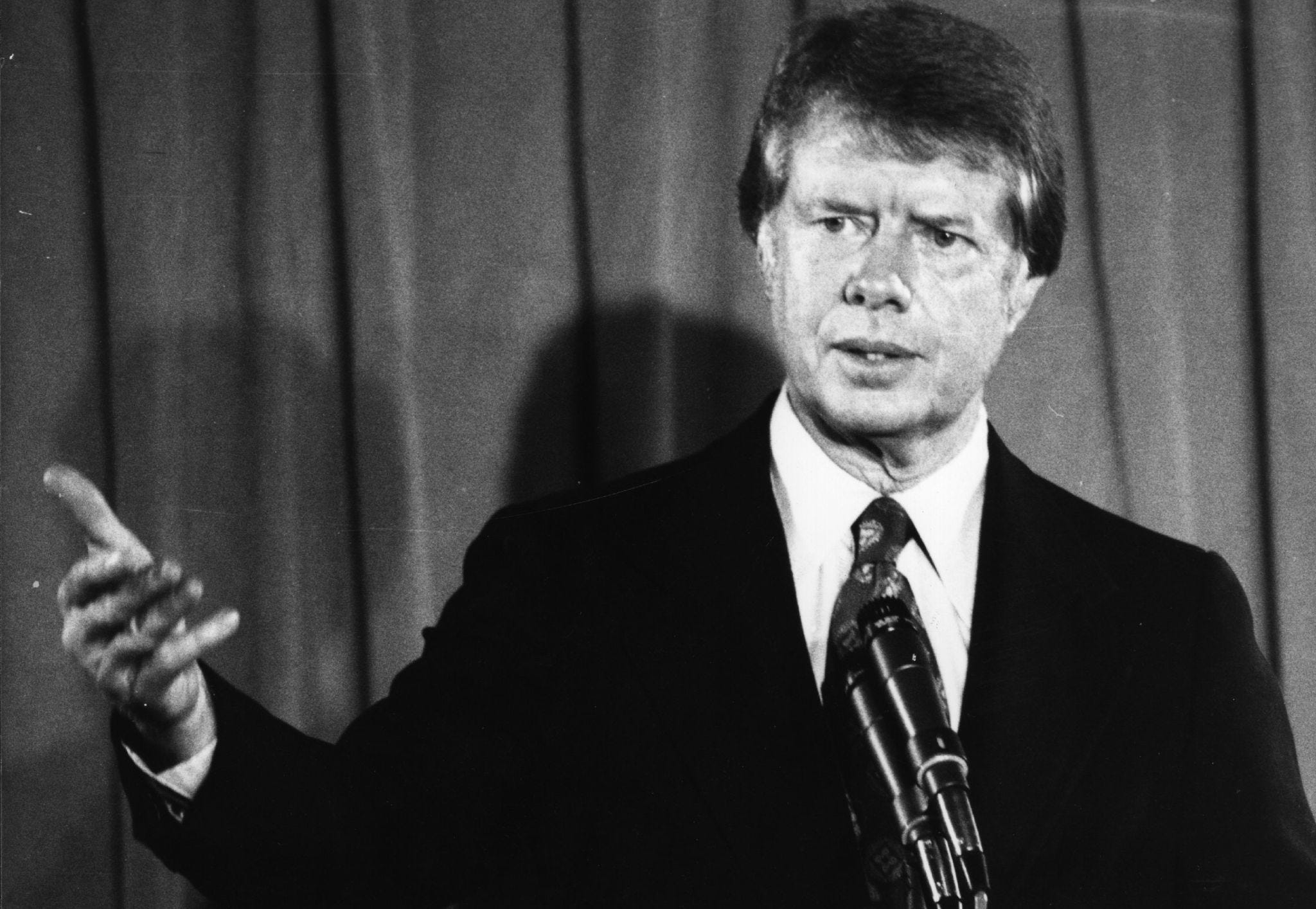
The year is 1979 …
And President Jimmy Carter is sitting in the Oval Office behind the Resolute Desk, delivering an address to the nation that will go down in American history as his most famous speech. Not only that, the speech will be remembered for its brutal honesty about America’s sorry state of affairs at this time, which included an energy crisis, high inflation and stagflation, high unemployment, high government spending, a declining dollar, and the beginning of American manufacturing jobs going overseas. For all his faults, Carter did what few modern presidents have ever done: he actually admitted that things were quite bad, and that Americans were souring on both the economy and our system of government. Carter did not sugarcoat it, nor shy away from what normal Americans had to say about the country, none of which was good. Carter, in fact, had invited dozens of citizens and politicians to Camp David, where they could voice their concerns directly to the president. He took their concerns to heart, later giving them a voice in his address July 15, 1979, which has since become known as the “Crisis of Confidence” or the “Malaise” speech.
Carter said, in part:
It is a crisis that strikes at the very heart and soul of our national will. We can see this crisis in the growing doubt of the meaning of our own lives and in the loss of unity and purpose as a Nation. The erosion of confidence in the future is threatening to destroy the social and political fabric of the nation.”
His description of Washington, D.C., and Congress still rings true today:
What you see too often in Washington and elsewhere around the country is a system of government that seems incapable of action. You see a Congress twisted and pulled in every direction by hundreds of well-financed and powerful special interests. You see every extreme position defended to the last vote, almost to the last breath by one unyielding group or another. You often see a balanced and a fair approach that demands sacrifice, a little sacrifice from everyone, abandoned like an orphan without support and without friends.
And, in one of the most stirring moments, he summarized what a Camp David visitor had told him:
One of the visitors to Camp David last week put it this way: “We’ve got to stop crying and start sweating, stop talking and start walking, stop cursing and start praying. The strength we need will not come from the White House, but from every house in America.”
Unfortunately for Carter, the speech was a positive but very fleeting moment in a presidency that would still go on to sink thanks to stagflation, joblessness, the Iranian hostage crisis, and an energy crisis, among other problems. Carter could not escape his fate. But at least he was willing to call it like it is, in a manner that was unifying and benevolent, which is something no politician today would ever have the courage to do.
New Release
Inside CECOT: The World’s Most Dangerous Prison
The Daily Caller went where almost no Western media has gone: inside CECOT, El Salvador’s controversial maximum security mega-prison.
We sat down with the prisoners themselves. We talked to the senior officials who run it. We found out what’s actually happening inside the walls.
Inside CECOT: The World’s Most Dangerous Prison is streaming now for just $1.
Like what you’re reading? If so, please consider subscribing to State of the Day or sharing this with a friend. You’d be supporting this newsletter and helping keep independent journalism alive.
If you are already a paid subscriber, make sure to join the conversation in our subscribers-only chat below.


