


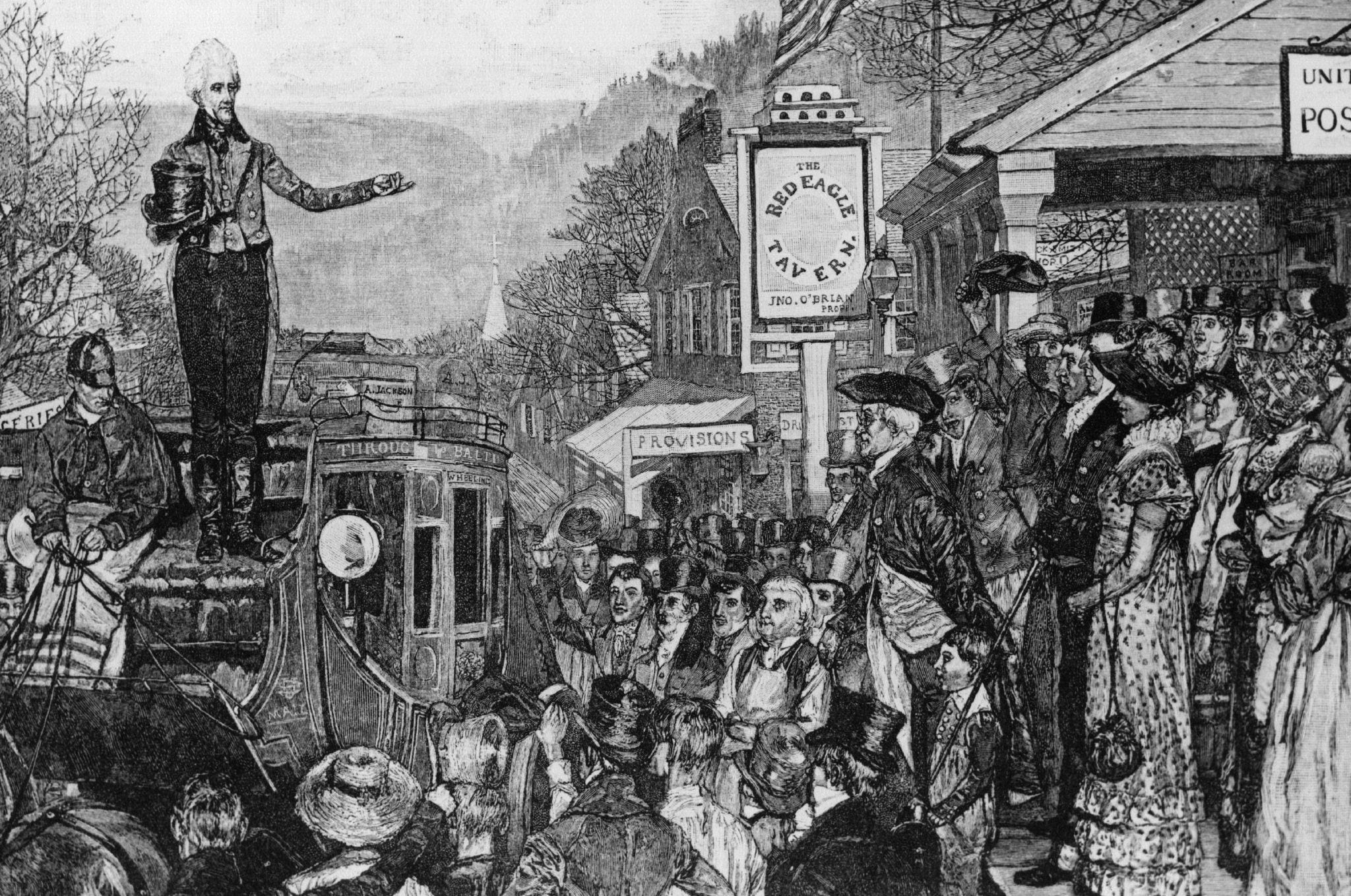
The year is 1832 …
And President Andrew Jackson is waging his famous bank war against the Second Bank of the United States, which was established by Congress in 1816. Just as the first national bank, created in 1791, sparked a fiery constitutional debate among key Founding Fathers such as Alexander Hamilton, the first Secretary of the Treasury, and Thomas Jefferson, so, too, did the second bank. Jackson, like Jefferson and (at first) James Madison before him, believed that Congress did not have the power to form a national bank and that its creation was an act of corruption that only benefited the monied and well-connected financial elites. Jefferson had argued the First Bank’s connection to constitutionally authorized powers was feeble and that it violated property laws, while Madison’s opposition primarily hinged on the Constitution’s 10th Amendment — that all powers not endowed to Congress are retained by the states or the people.
However, as president, Madison would sign the act that established the Second Bank in 1816. After the War of 1812 against the British, the United States was deep in debt, as it had been after the Revolutionary War, and the government needed a way to help finance the country’s westward expansion amid an economic downturn and to issue a stable, uniform currency across the states. The Second Bank was not a modern central bank and did not set monetary policy as the term is understood today. Rather, the bank’s 25 branches gave farmers and businesses loans, which help finance agricultural output, manufacturing, and the distribution of goods domestically and to international markets.
When Congress tried to extend the Second Bank’s charter in 1832, which was supported by East Coast merchants, National Republicans, and Kentucky Sen. Henry Clay (the Mitch McConnell of his time), Jackson issued his famous veto July 10. The president wrote, in part:
It is to be regretted that the rich and powerful too often bend the acts of government to their selfish purposes. Distinctions in society will always exist under every just government. Equality of talents, of education, or of wealth can not be produced by human institutions. In the full enjoyment of the gifts of Heaven and the fruits of superior industry, economy, and virtue, every man is equally entitled to protection by law; but when the laws undertake to add to these natural and just advantages artificial distinctions, to grant titles, gratuities, and exclusive privileges, to make the rich richer and the potent more powerful, the humble members of society—the farmers, mechanics, and laborers—who have neither the time nor the means of securing like favors to themselves, have a right to complain of the injustice of their Government.
Both Jefferson and Jackson’s populist message will sound quite familiar to Americans paying attention to our modern political moment. Many of our most hotly contested debates, especially those that pertain to the role of Wall Street in American society and how it distorts the political system, stem from this original ideological divide: the Jeffersonians/Jacksonians vs. Hamiltonians. Jackson, like many Americans today, believed that an excessively big bank tethered to the federal government would lead to a proliferation of corrupt rent-seekers — people who gain “exclusive privileges” through loopholes and their connections to the powerful, at the expense of ordinary citizens without such access.
Like what you’re reading? If so, please consider subscribing to State of the Day or sharing this with a friend. You’d be supporting this newsletter and helping keep independent journalism alive.
If you are already a paid subscriber, make sure to join the conversation in our subscribers-only chat below.


