


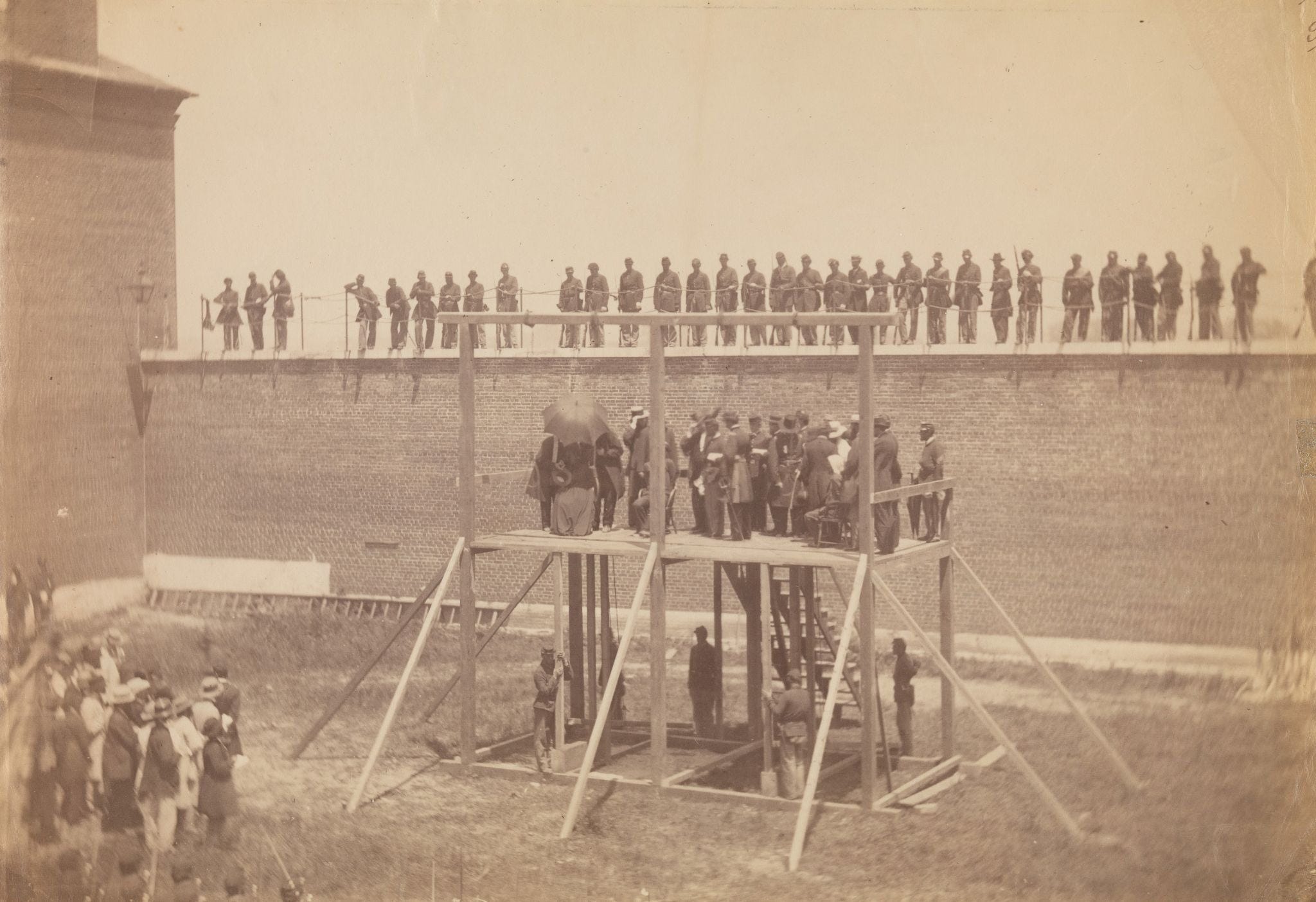
The year is 1865 …
And four conspirators in the assassination of President Abraham Lincoln — David Herold, Lewis Powell, George Atzerodt, and Mary Surratt — stand atop a 12-foot gallows in the courtyard of the Old Arsenal Penitentiary in Washington, D.C. In May, a military tribunal ordered by President Andrew Johnson found them guilty and sentenced them to death. Powell had been tasked with assassinating Secretary of State William H. Seward the night of Lincoln’s assassination, but he only left Seward, his son, and a bodyguard severely injured. Herold helped Powell, while also assisting John Wilkes Booth’s escape after he shot Lincoln at Ford’s Theatre. Surratt owned a boarding house in Washington, D.C., where the conspirators met and hatched out their plans. Atzerodt was supposed to assassinate Johnson, but lost his nerve and spent the night drinking at a hotel bar. Four other conspirators, Dr. Samuel Mudd, Samuel Arnold, Michael O’Laughlen, and Edman Spangler, were also found guilty but evaded the death sentence.

Use code STATEOFTHEDAY for your first month free.
It is early in the afternoon, and it is hot. It is believed the temperature that day exceeded 100 degrees. You can imagine their flushed faces sweating profusely under their execution hoods. Last rites are read in the sweltering heat, and shortly after 1:30 pm, the trap door opens. Atzerodt reportedly yells out, “May we meet in another world.” The conspirators die within minutes, and their bodies will swing for another 25 before they are cut down.
Notably, Surratt was the first woman ever executed by the federal government in U.S. history. Her conviction and sentencing in the Lincoln assassination plot faced some criticism at the time, as the evidence against her was largely circumstantial and centered around her acquaintance with the other conspirators. Her lawyer and sister, Anna, fought for clemency up until the bitter end, and many in the crowd gathered at the Old Arsenal Penitentiary believed her life would be spared with a last-minute intervention. But history had different plans, as it so often does.
Like what you’re reading? If so, please consider subscribing to State of the Day or sharing this with a friend. You’d be supporting this newsletter and helping keep independent journalism alive.
If you are already a paid subscriber, make sure to join the conversation in our subscribers-only chat below.


